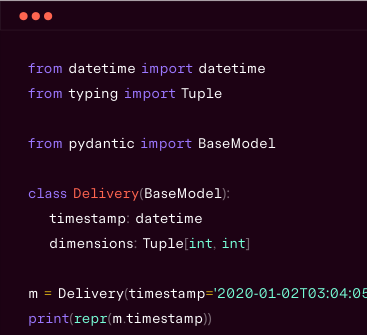
Pydantic, the data validation library for Python, just crossed 10 billion downloads.
Open source is the core of what we do at Pydantic, the company. So let's rewind a bit.
The year was 2017 and Samuel Colvin released Pydantic.
It all started out of frustration that type hints did nothing at runtime and curiosity as to whether they could be used to validate data.
— Samuel Colvin
Turns out he was right. And with a bit of luck, the tool grew exponentially. The proof that it was a problem worth solving.
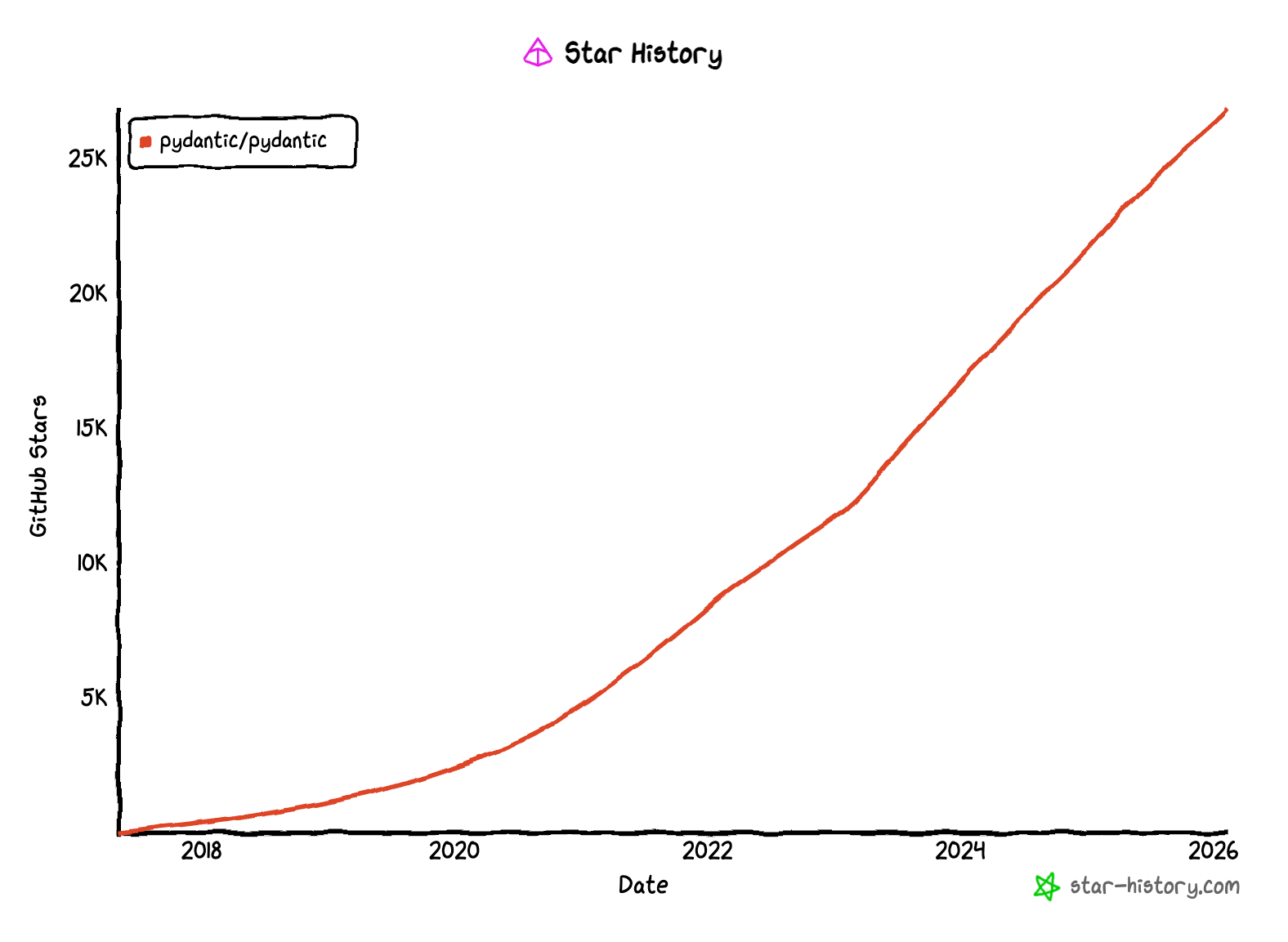
Some stats: Pydantic's repo now has 27K stars, over 550M downloads per month, more than 700 contributors, and is used by all FAANG companies and 20 of the 25 largest companies on NASDAQ. Pydantic is a dependency for more than 900K GitHub repositories and is one of the most-used Python packages in existence.
The story
Pydantic v1.0 was released in October 2019. At the time, there were 58K total downloads and 1.5K GitHub stars. Things have grown a lot since then. By February 2023, the library had 40M downloads per month. The release of v2.0 came in June 2023.
The community pushed back hard because of the breaking changes. I personally remember watching Marcelo Trylesinski's talk (right before mine) at a Python event in October 2023 and the number of questions from users who were still frustrated by the v2.0 migration. That's what happens when developers rely on your tool.
The migration was real, the frustration was real, and the community came through it. If you're still struggling with v1 to v2 watch Marcelo's tutorial on Pydantic V1 to V2: The Migration, it's worth your time.
And yet, none of that slowed things down. From 40M monthly downloads in early 2023 to over 550M per month today. 10 billion total. That's the kind of growth that only happens when developers genuinely love a tool.
The company
2023 was also the year Sequoia approached Samuel to start a partnership and build Pydantic Logfire. That marks the birth of Pydantic, the company.
Pydantic started as a side project. Today, it's downloaded more than TypeScript and used by millions of developers in companies of all sizes. It has changed my life by allowing me to start this company and build the observability tool I've dreamed of for years.
— Samuel Colvin
Observability with Logfire
Similar to Pydantic data validation, Pydantic Logfire was built out of frustration with existing AI observability tools. Most of them are designed to serve the needs of large enterprises, and the resulting complexity often outweighs the insights they provide. We carried the same focus on developer experience that made Pydantic successful into the observability space.
Logfire is built on top of OpenTelemetry. We have a beautiful, MIT-licensed open source SDK that wraps OTel and provides a nice API for Python, TypeScript/JavaScript, and Rust. The platform itself is closed source. That said, you can choose to use our SDK and export your traces elsewhere. While we offer a generous free tier with 10 million records a month, our goal is for you to find enough value in Logfire to decide to pay for it.
Our open source ethos
10 billion downloads doesn't happen because of one tool. It happens because of an ecosystem, and because of a commitment to building in the open.
We are a member of the Open Source Pledge and the AI Agentic Foundation. We use open source to build our tools, and we support the maintainers who make our ecosystem possible.
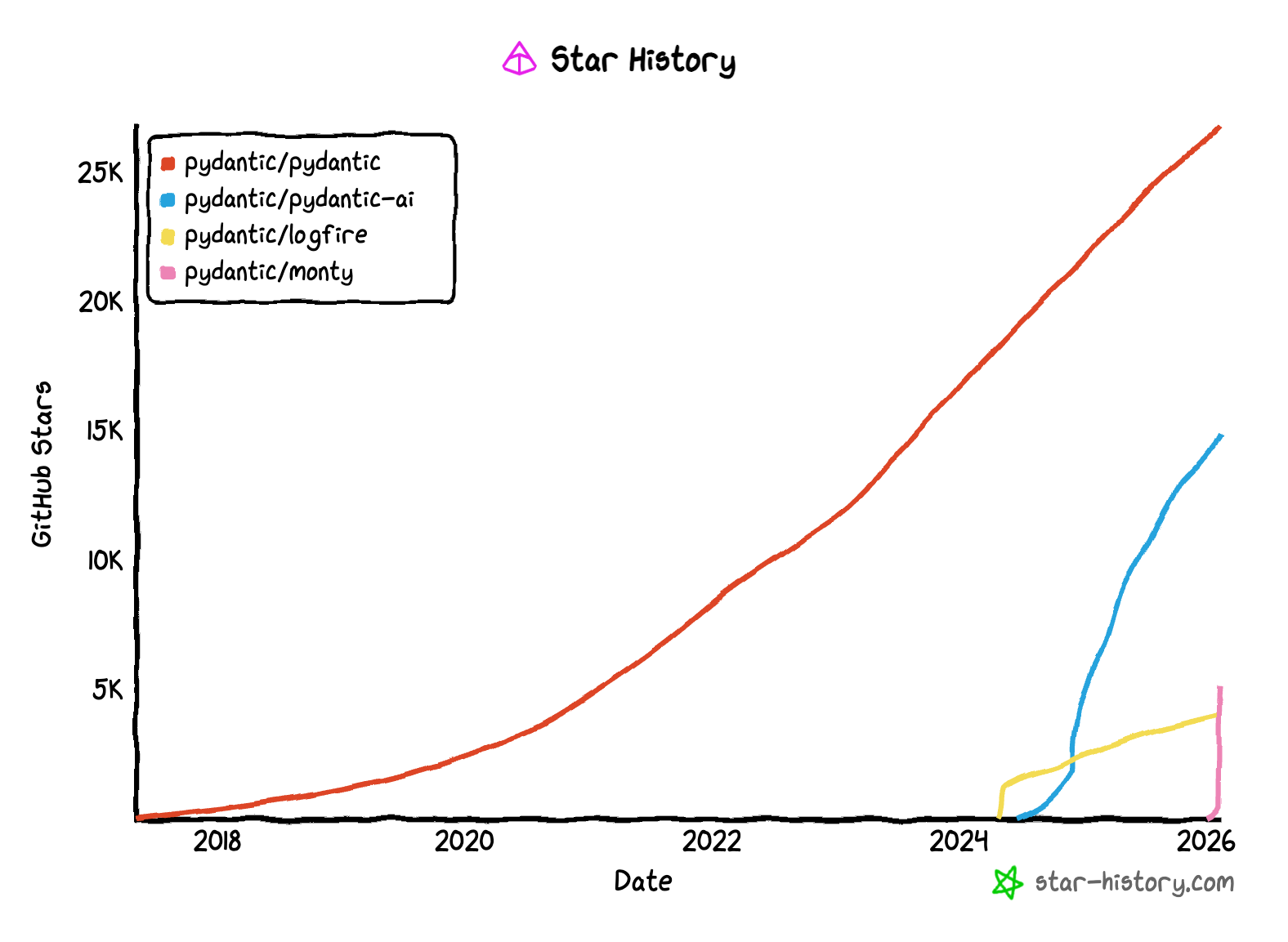
In October 2024, we built and open sourced Pydantic AI, our AI agent framework. With 8 million downloads per month, Pydantic AI was the fastest-growing agent framework by downloads in 2025.
A few weeks ago, we released Monty, a new Python implementation built from scratch in Rust, designed for LLMs to run code without host access. The idea is simple: LLMs can work faster, cheaper, and more reliably if they write Python (or JavaScript) code instead of relying on traditional tool calling. Monty makes that possible without the complexity of a sandbox or the risk of running code directly on the host. Monty will soon power Code Mode in Pydantic AI.
What's next
From a side project in 2017 to 10 billion downloads in 2026. From a one-person library to a company building the tools that developers actually want to use.
None of this would have happened without our community: the contributors, the maintainers, the developers who adopted Pydantic early, the critics, and everyone building and using Pydantic AI and Logfire today.
We're just getting started. Thank you for being part of it.
Come work with us
Speaking of what's next: Logfire is taking off! We're seeing massive momentum in AI observability and evals. Now, we're ready to scale the Sales team. Curious if the role is for you? Have a look at the roles we're hiring for here - no recruiters, please.
Join us at PyAI
Pydantic's first ever conference!
AI runs on Python: the models, the agents, the systems going to production. We have the best line-up with Guido van Rossum (creator of Python), Jason Liu, Pamela Fox, Armin Ronacher, Jeremiah Lowin, Samuel Colvin and other incredible people joining us.
Grab your PyAI ticket!