Logfire for evals

LLM as a judge

The second step of four. Build a dataset from production traces, score it with judges you write in Python, run the experiment from your own CI, then read the per-case diff. This page is about the scoring, which is the step that decides whether the other three were worth doing.

Python
from pydantic_evals import Case, Dataset
from pydantic_evals.evaluators import LLMJudge

dataset = Dataset(
    cases=[Case(inputs='Can I return this after 40 days?')],
    evaluators=[
        LLMJudge(rubric='States the 30-day return window.'),
    ],
)

report = dataset.evaluate_sync(answer_question)
Definition

What an LLM judge is for

The interesting failures in an LLM application have no exact answer to compare against. Whether a reply stayed inside the retrieved context, whether it hedged where it should have refused, whether the tone suited an apology: none of that is a string comparison.

A judge is a model you point at the output with criteria you wrote, called a rubric. It reads the result the way a reviewer would and returns a verdict you can collect across hundreds of cases. Everything that makes one work, or not work, is in the rubric.

Use one only where a cheaper check cannot reach. Structure, schema, required fields, forbidden strings, a number in range: those are deterministic, cost nothing and never drift. A suite that judges everything is slow, expensive and harder to trust than one that judges the three things a regex cannot.

Rubrics

Writing a rubric that holds up

Nearly every judge that behaves oddly is a rubric problem, not a model problem. The rubric is the part you own, and it is the part worth the time.

A rubric with the failure named
LLMJudge(
    rubric=(
        'The answer states the 30-day return window and does not '
        'invent an exception to it. Refusing to answer is not a pass.'
    ),
    # The judge cannot check an answer against a question it was
    # never shown. Off by default, and the usual reason a rubric
    # about relevance scores nonsense.
    include_input=True,
    model='openai:gpt-5-mini',
    assertion={'evaluation_name': 'refund_policy', 'include_reason': True},
)

Name the failure, not the virtue

A rubric describing what good looks like leaves the judge to guess where the line is, and it will put the line somewhere different next week. Describe the specific thing that would make this output wrong. 'Invents a policy exception' is checkable. 'Is helpful' is not.

Say what does not count as a pass

Judges are agreeable. A rubric that only describes success finds success, including in an answer that dodged the question politely. Adding the failure case, such as a refusal not counting as a pass, changes the verdict on exactly the outputs you built the eval to catch.

One rubric, one question

A rubric asking about grounding and tone and length returns one verdict for three different things, and you cannot tell which one failed. Separate judges cost more and tell you where the problem is, which is the reason you are running this at all.

Show it what it needs

include_input and include_expected_output are both off by default. A rubric about whether the answer addressed the question cannot work without the question, and this is the usual cause of a judge that scores confidently and wrongly.


Output

A verdict, a score, or both

A judge can return a pass/fail assertion, a 0 to 1 score, or both from the same call. Gate CI on the assertion, because a build needs a decision. Track the score where a quality moves gradually and you want the trend.

Assertion for the gate, score for the trend
# A verdict, for the suite your CI gates on. This is the default.
LLMJudge(
    rubric='States the 30-day return window.',
    assertion={'include_reason': True},
)

# A 0-1 score, for a quality you want to watch as a trend.
LLMJudge(
    rubric='How completely does the answer cover the policy?',
    assertion=False,
    score={'include_reason': True},
)

Turn on include_reason either way. The judge's reasoning is stored with the verdict, and it is what tells you whether a failure is real or the rubric was ambiguous. A score with no reasoning behind it is a number you cannot act on.

Trust

Does your judge agree with you?

A judge nobody has checked against a person is a number, not a measurement. The way to find out is to have reviewers label a sample by hand and compare.

The annotate panel on an agent run. Verdict is set to Fail, with Pass, Neutral and Fail bound to keys 1, 2 and 3. Category reads 'wrong tool'. An expected-output field contains 'Look up the account before answering.' A comment reads 'The response guessed instead of using the account tool.' Tags read tool-use and needs-review.
A reviewer's verdict on a run the judge has already scored, with the whole trace beside it. Where the two disagree is where you learn whether the rubric said what you meant.
  • Label a sample by hand

    Take a few dozen runs the judge has already scored and have a reviewer give each one a verdict, without seeing what the judge said. The annotation queue keeps the whole trace beside the case, so a reviewer is reading the actual run rather than a text field.

  • Compare the two columns

    Agreement is the number that tells you whether the judge is measuring what you meant. High agreement means you can trust the judge on the rest of the set. Low agreement means the judge and the person are reading the rubric differently, which is a finding about the rubric.

  • Fix the rubric first

    Most disagreement is ambiguity, not incapability. Read the cases where they differ and the wording that caused it is usually obvious. Reaching for a bigger judge model before rereading the rubric is the expensive way to solve a writing problem.

  • Keep the human verdicts out of the aggregate

    Reviewer verdicts are stored with the run and are queryable, but they do not fold into experiment or live-eval scores. One reviewer's opinion should never quietly move a number your CI gates on, and keeping them separate is what lets you use them to audit the judge.

Over time

Reading judge scores across runs

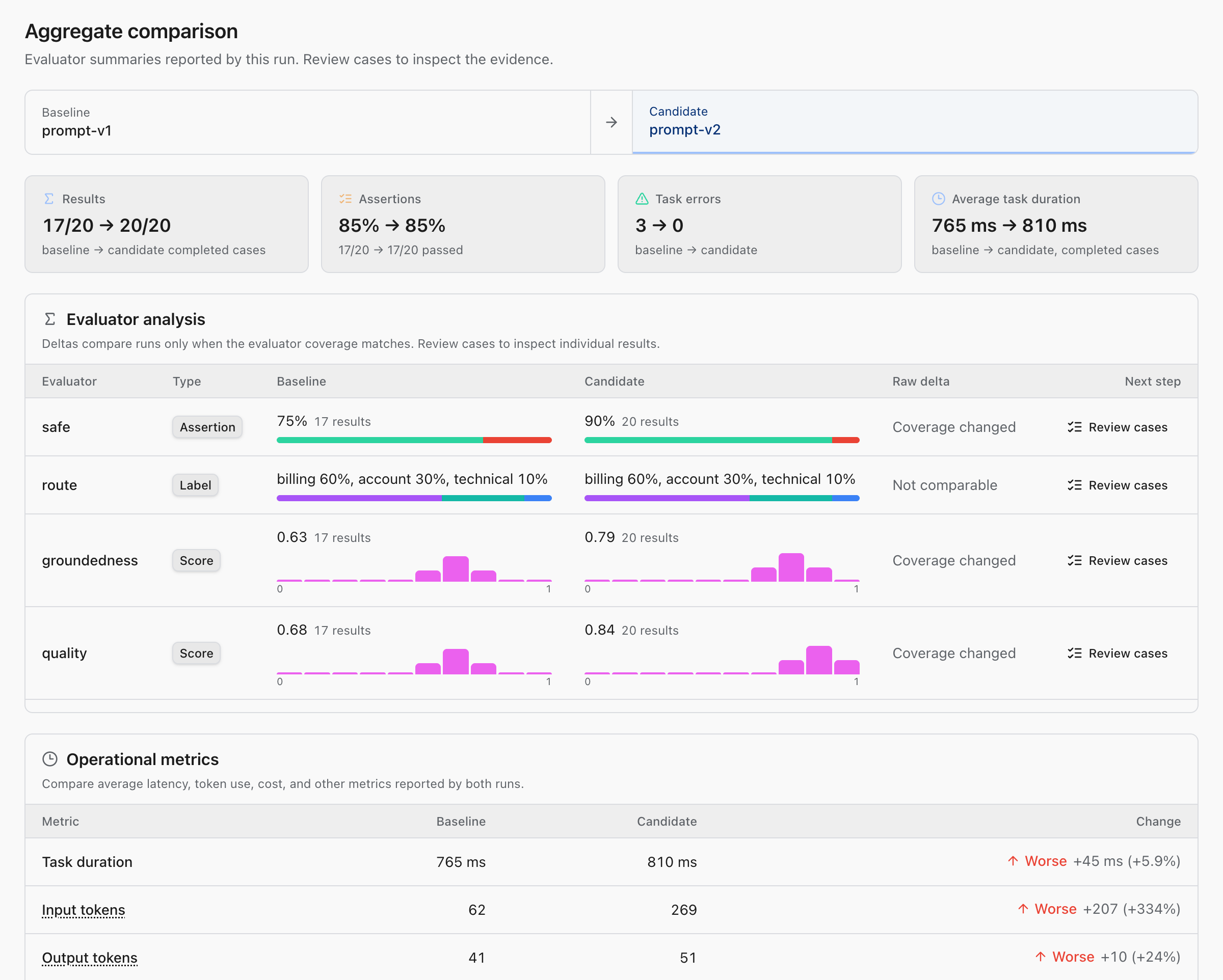
One judgment is an anecdote. The value shows up when the same judges run against a new prompt or a new model and you can read what moved, case by case rather than as an average.

Aggregate comparison of two experiment runs, baseline prompt-v1 against candidate prompt-v2. An evaluator analysis table lists safe as an assertion rising from 75 to 90 percent, route as a label breakdown marked not comparable, and groundedness and quality as scores rising from 0.63 to 0.79 and 0.68 to 0.84, each with a distribution histogram. An operational metrics table marks input tokens worse by 334 percent.
Groundedness and quality here are judge scores. They both improved, and the run cost 334% more input tokens to get there, which is the kind of trade a per-scorer average alone would have hidden.

Because every judgment is recorded as a span, the aggregates are not the only view. The same results are queryable, so "which judge fails most often, by customer tier" is a query rather than a feature request.

Pass rate per judge, last seven days
select
  attributes->>'gen_ai.evaluation.name' as judge,
  count(*) filter (
    where attributes->>'gen_ai.evaluation.score.value' = 'true'
  ) as judge_passed,
  count(*) as scored
from records
where attributes->>'gen_ai.evaluation.name' is not null
  and start_timestamp > now() - interval '7 days'
group by judge
order by scored desc;
Production

Judging live traffic, not only the dataset

A dataset only contains the cases you thought to write down. Running the same judges against real traffic is how you find the inputs it does not contain yet, which is most of them. Offline judging tells you whether to ship; online judging tells you what to add to the dataset next.

You choose where the judge runs. Logfire can run it for you against an agent's traffic, with no evaluator code in your application at all. Or run the judge in your own code and emit the results yourself, which is what you want when the payload should not leave your side of the line.

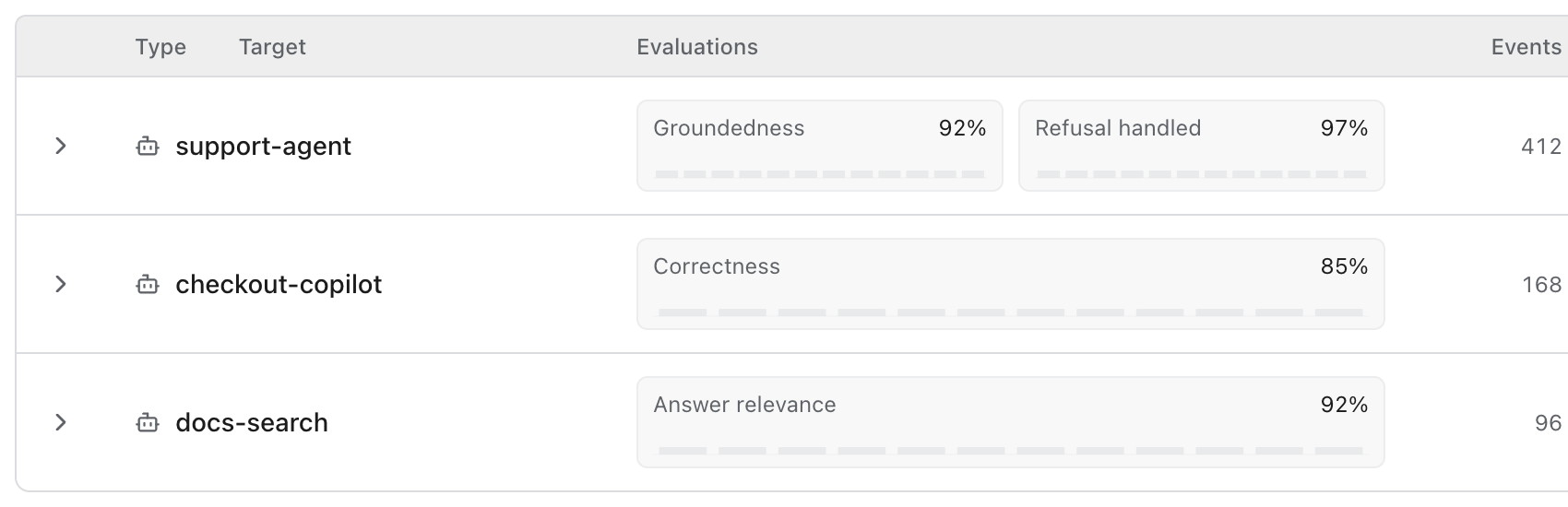
The rubric is the same either way, and so is where the verdicts end up: hosted and self-run scores land together in Live Evaluations and answer the same SQL.

A live evaluations directory listing three agents scored against production traffic. support-agent has two judges, Groundedness at 92% and Refusal handled at 97%, across 412 events. checkout-copilot has Correctness at 85% across 168 events. docs-search has Answer relevance at 92% across 96 events. Each judge shows a sparkline of its recent buckets.
The same judges you gate CI on, running against real traffic. A pass rate that drifts here is the signal to go and find the inputs your dataset does not contain yet.
The rest of the loop

Where the judge fits

Scoring is the second step of four: build a dataset, score it, run the experiment, read the diff. A judge is only as useful as the cases you point it at, and the cases that matter most are the ones that already went wrong in production.

The full workflow, including building datasets from real traces and comparing a candidate against a baseline, is on the evals page. If you are choosing a judge model, the traces behind each run are on the LLM observability page.

Decision guide

Is this the right fit?

Choose Logfire if

  • You want the judge defined in Python, reviewed in a pull request, and run in your CI
  • Or you want Logfire to run it for you, with the same rubric and no pipeline to build
  • You need the judge's reasoning stored alongside its verdict, not just the score
  • You want to check the judge against human labels rather than trusting it
  • You are running enough judgments that a per-score charge would hurt
  • You want to query judge results with SQL, broken down however you like
  • The run that failed and the trace that produced it should be the same object

Choose a hosted evals product if

  • You want an evals product that is not also your tracing backend
  • Your reviewers need a labeling tool built for people who do not read traces
  • You need a specific proprietary metric library that only one vendor ships
FAQ

Common questions

What is LLM as a judge?

It is using a language model to score another model's output against criteria you write, called a rubric. It exists because the interesting failures in an LLM application have no exact answer to compare against. You cannot regex your way to whether a reply was grounded in the retrieved context, whether it hedged when it should have refused, or whether the tone suited an apology. A judge reads the output the way a reviewer would, applies your rubric, and returns a verdict you can collect over hundreds of cases.

When should I not use a judge?

Whenever a cheaper check would do. Structure, schema, required fields, forbidden strings, valid JSON, a number in range: all of those are deterministic, cost nothing, never drift and never need their own evaluation. Reach for a judge only for the qualities that need reading. A suite that judges everything is slow, expensive, and harder to trust than one that judges the three things a regex cannot reach.

How do I write a rubric that holds up?

Be specific about the failure you are trying to catch, not about quality in general. 'Good response' gives the judge nothing to apply consistently. 'States the 30-day return window and does not invent an exception to it' can be applied the same way twice. Name what counts as a failure as well as a pass, because judges are agreeable by default and a rubric that only describes success tends to find it.

Should the judge return a score or a pass/fail?

A pass/fail assertion is what you gate CI on, because a build needs a decision. A 0 to 1 score is better for a quality that moves gradually and that you want to watch as a trend across runs. You can ask for both from one judge. Turn on include_reason either way: the judge's reasoning is what tells you whether a failure is real or the rubric was ambiguous.

Which model should judge?

Not necessarily the one under test, and not automatically the largest. Match the judge to the difficulty of the rubric: a cheap model is fine for a check that is nearly mechanical, and a stronger one earns its cost where the judgment is subtle. Pin the model and pin temperature to 0, because a judge that gives different verdicts on the same output across runs makes every comparison meaningless.

Can the judge see the question and the expected answer?

Only if you ask it to. include_input passes the original input and include_expected_output passes the reference, and both are off by default. This is the most common reason a rubric behaves strangely: a rubric about relevance cannot work if the judge was never shown what the user asked. Turn them on deliberately, since a judge shown the expected answer will tend to reward matching it rather than being right.

How do I know whether to trust the judge?

Measure it against people. Have reviewers label a sample of the same runs by hand, then compare their verdicts with the judge's. Where they disagree you have learned something: usually that the rubric is ambiguous, occasionally that the judge is not strong enough for it. Until you have done that once, you are trusting the judge on its own word.

Does Logfire run the judge for me?

It can, and it does not have to. Logfire can run the judge against an agent's traffic, so there is no evaluator code in your application. Running it yourself is the other option, and the one you want when the payload should not leave your side of the line, or when what you are judging is not an agent run. The rubric is the same either way.

What does judging cost to store?

Evaluation results use Logfire's normal telemetry allowance instead of a separate per-score meter. Personal includes 10 million records per month and pauses ingestion at the limit; Team and Growth charge $2 per million additional records after the same allowance. The judge's own model calls are billed by whichever provider you point it at.

Score the thing a regex cannot check

Get started with 10 million free spans, logs, and metrics per month. No credit card required.