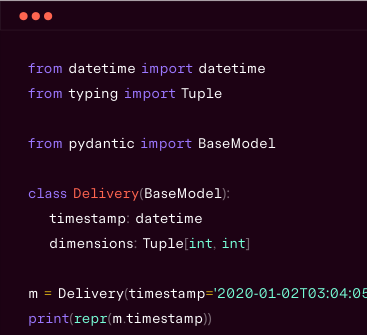
I've noticed some strange behavior coming out of the top frontier models lately. Models are getting better and better at coding, design, problem solving, and more. However, when it comes to prose, I can no longer stand the output. It's absolutely infuriating. What has caused this?
Most recently Anthropic Claude models began using the word "seam" to represent any point in a software (or otherwise) system where two components connect. I have never heard this term used before. While I don't consider myself authoritative in software terminology, typically I would use the term "interface" or maybe even something as basic as "contract" (SDK or API contract, right?). I don't think I'd ever heard "seam" to represent this, however, until recently when Fable 5 started barfing it everywhere into my codebases.
And we're going to attempt to address this phenomenon with a Pydantic AI Capability. Your mileage may vary, but at the very least, my words may strike a chord with your intellectual and philosophical side, and additionally, you will see how easy it is to create agentic harness features using the powerful abstractions available in Pydantic AI and Pydantic AI Harness.
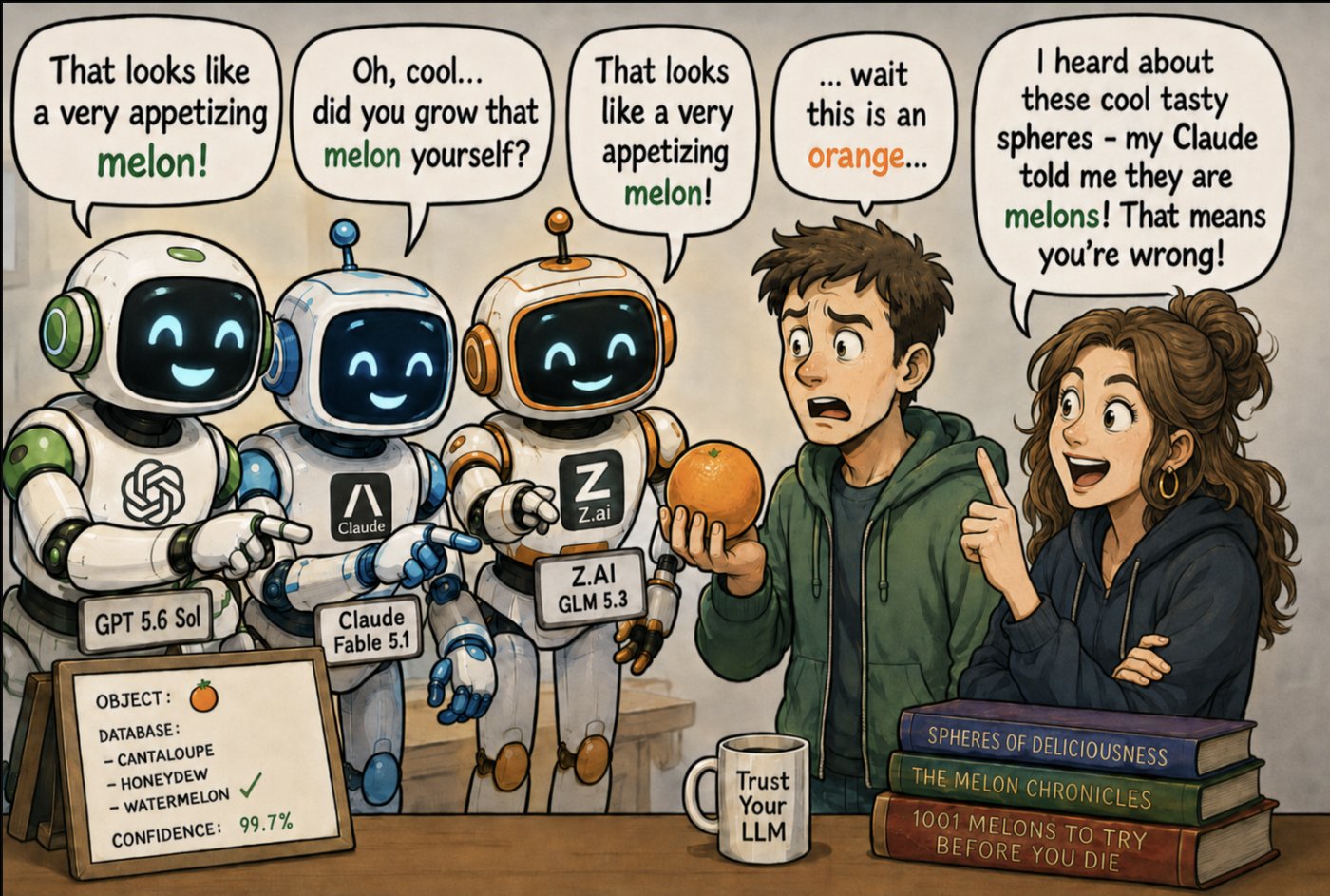
I cleared my context one day, and asked Fable 5.1: "Why are you talking about seams all the time whenever you are describing a point where software components meet?" Fable 5.1 got notably defensive and cited a book from 2004, Michael Feathers' Working Effectively With Legacy Code. Fable's rigorous reinforcement learning dug up an archaic term from decades ago and it has demonstrably proliferated.
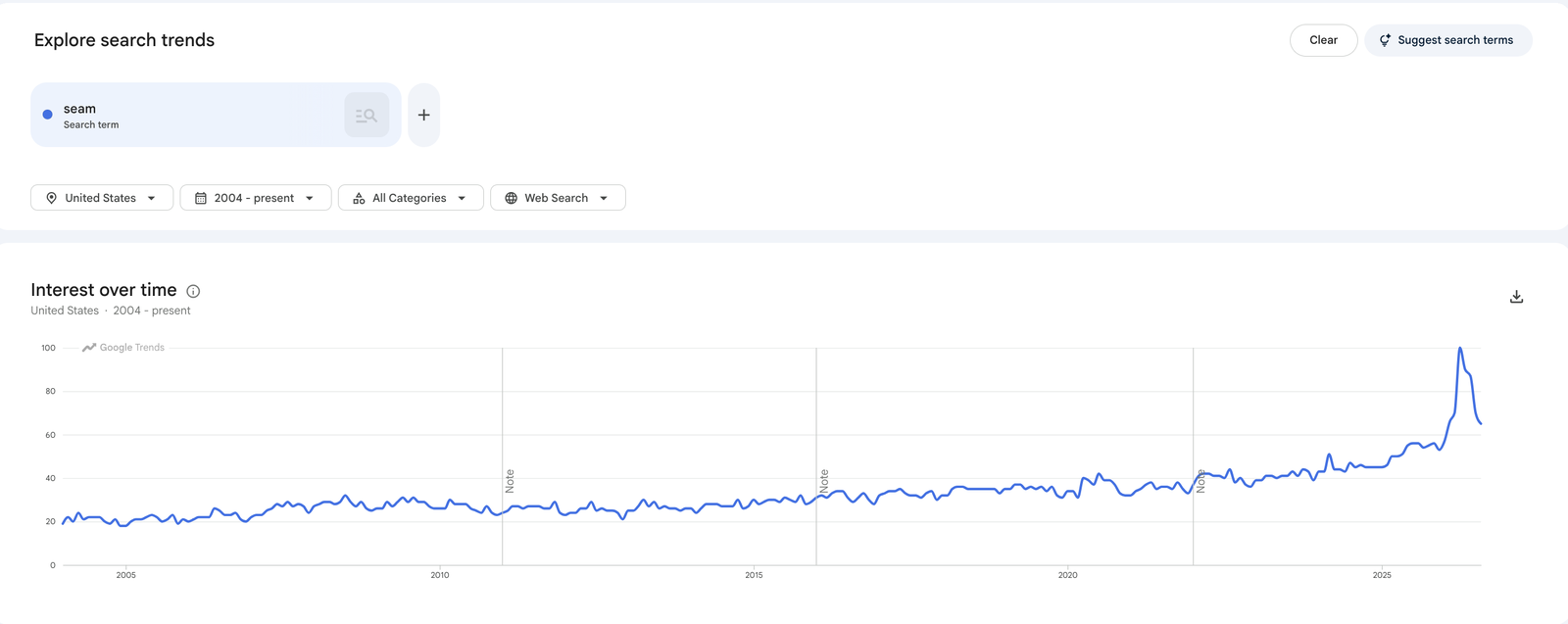
I showed it this Google Search Trends image, and Fable was justifiably defensive. The spike is very suspicious but seam obviously isn't a software-specific word. So I actually pointed it at GitHub and asked it to query PRs for the word "seam". It found ~700,000. ~685,000 of them are from 2026. The remaining ~15,000 were all from before 2026.
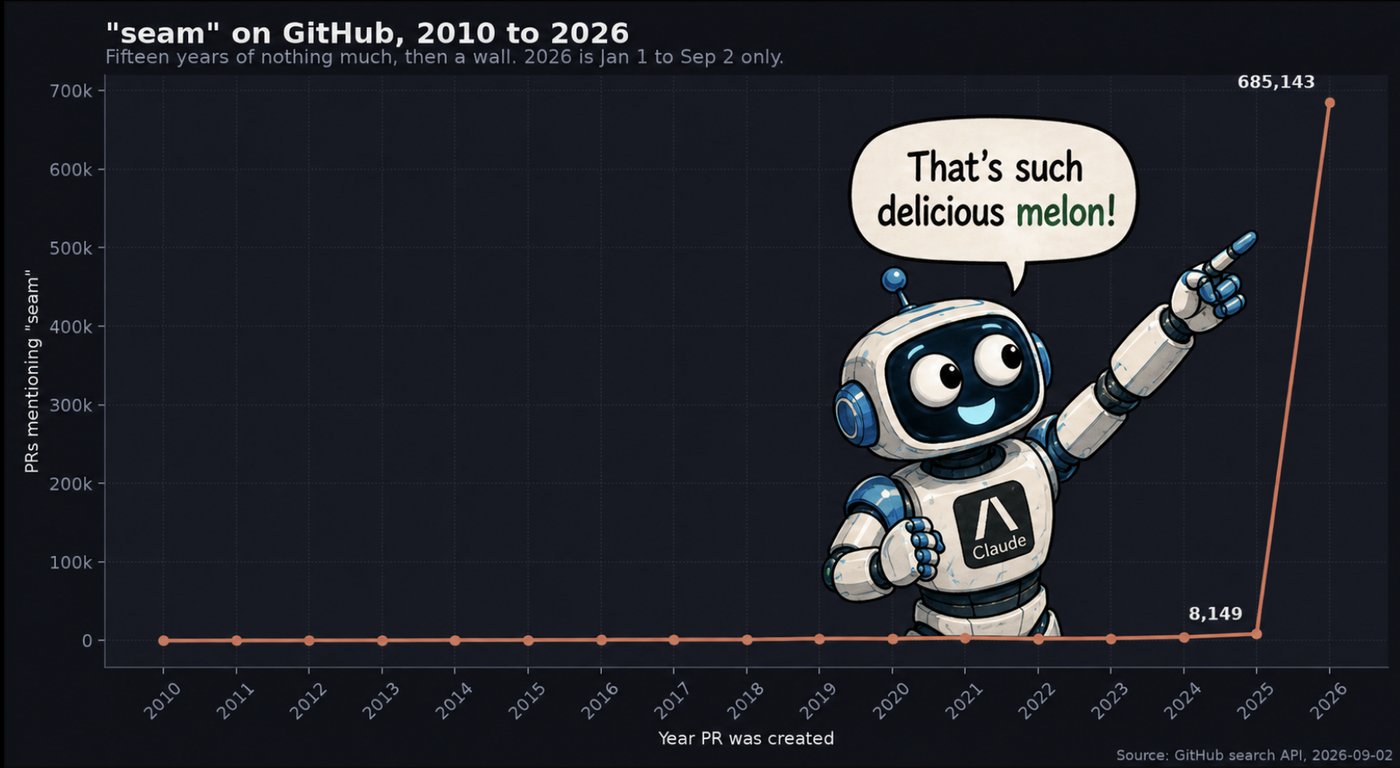
Then I asked Fable 5.1 if it could check to see if those PRs had the typical Claude Code co-authorship note in commit messages. The results are quite conclusive.
| Fingerprint in PR body | Count | Share of seam PRs | Share of all 2026 PRs | Over-rep. |
|---|---|---|---|---|
| "Claude Code" | 307,971 | 45% | 12.5% | 3.6x |
| "Generated with Claude Code" (exact footer) | 247,275 | 36% | ||
| "Codex" | 119,845 | 17.5% | 5.8% | 3.0x |
| "Copilot" | 53,726 | 7.8% | 5.2% | 1.5x |
| "Cursor" | 51,974 | 7.6% | ||
| "Gemini" | 25,514 | 3.7% | ||
| "Devin" | 4,970 | 0.7% |
And while this isn't wrong at all, per se, it does represent what I like to refer to as linguistic drift, which is something that I think all users of AI should be aware of, and potentially worried about.
Further aggravating is that the linguistic drift itself proliferates from one model to another. While I've been loving working with Anthropic Claude's Fable 5 (and now 5.1) for the past couple of months, my codebases are covered in the word "seam", in comments, in doc-strings, and in markdown files. Now, when I use OpenAI's GPT 5.6 Sol, DeepSeek v4 Flash 0731 (I love this model so much btw), Qwen 3.8 27b, or even the brand new Z.AI GLM 5.3 Flash, they all read my existing codebase and talk about "seams".
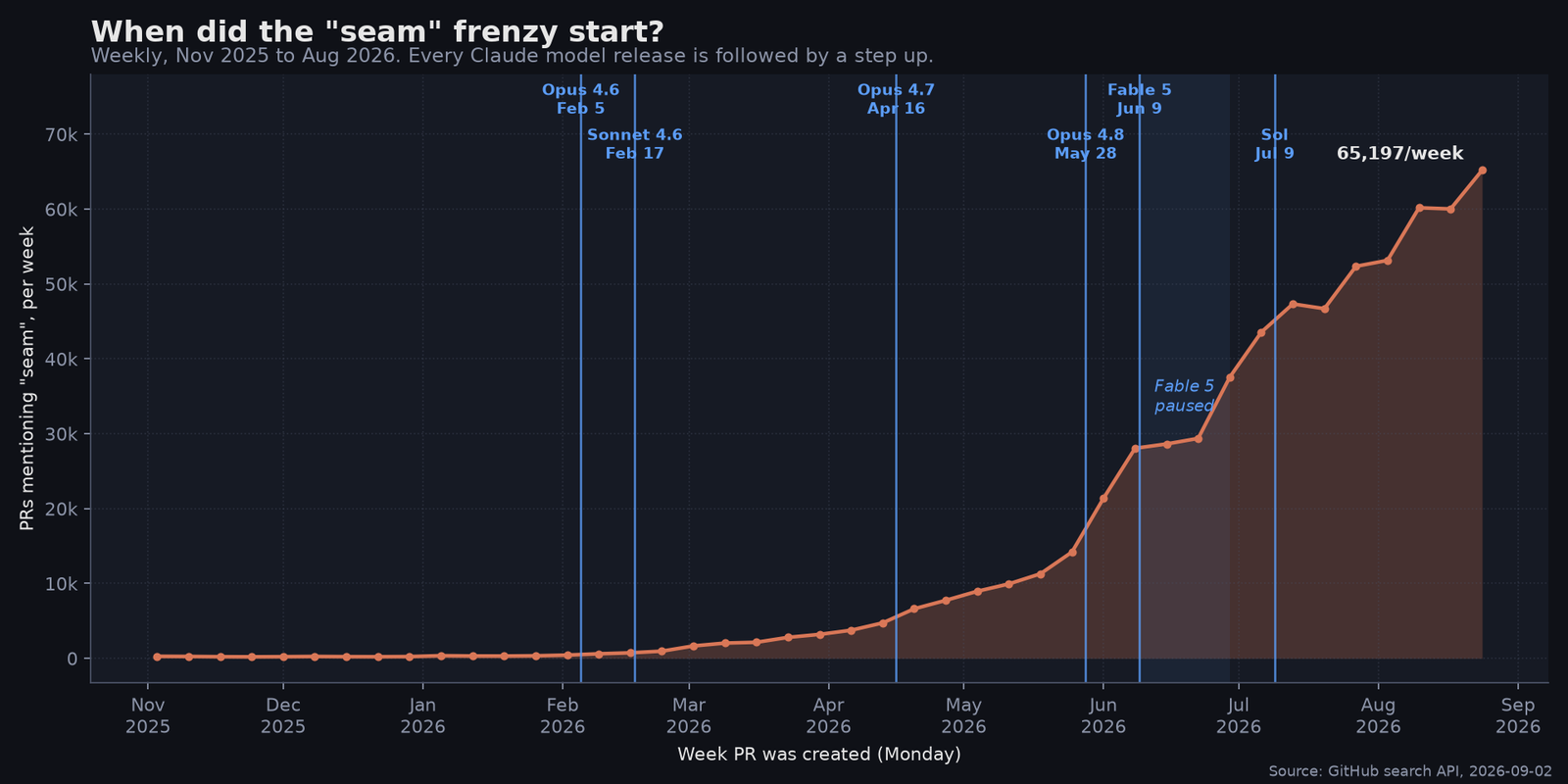
I had to go a little deeper. What was LLM Patient Zero? The answer is pretty clear. Opus 4.6 was Patient Zero, and the tendency to use the word seam slowly proliferated, later being amplified even further by Opus 4.7, and spiking hard when Opus 4.8 dropped.
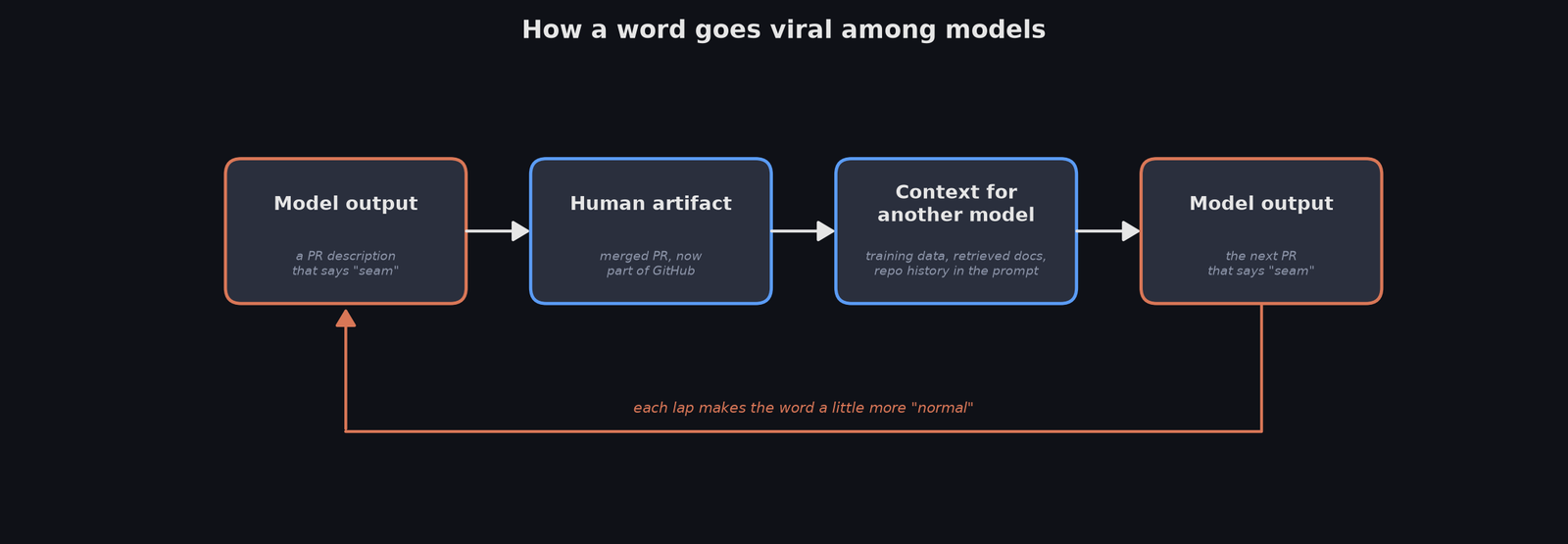
What we have here is a good old fashioned feedback loop. Oh boy!
It doesn't stop with "seam". It goes way deeper. I wanted to try to quantify this so I started scraping GitHub READMEs. Well, first I tried to get a dataset off of HuggingFace but didn't find much. I managed to scrape 4,319 pre-2025 READMEs stratified across 22 languages, and then 1,047 2026 READMEs from repos with Claude Code commits. On the pre-2025 set I had the constraint of greater than 500 stars to filter out pure slop. The 2026 set has no star filter. I fed them through a TF-IDF (Term Frequency - Inverse Document Frequency) vectorizer -> Singular Value Decomposition (SVD) -> t-SNE. Side note: omg yes I'm really using traditional NLP techniques because not everything needs to be a transformer.
Green = pre-2025
Orange = 2026
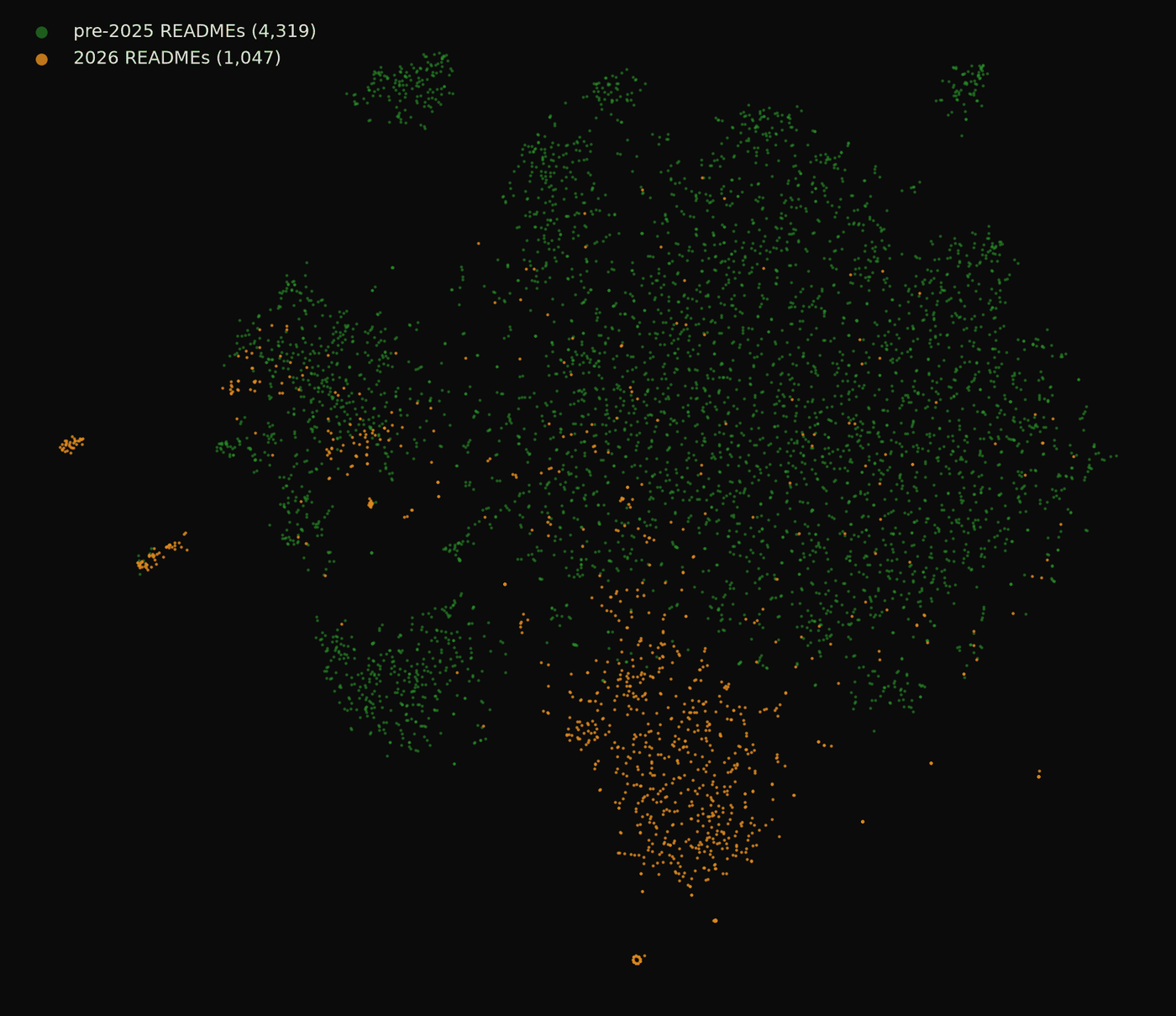
This is linguistic drift visualized.
Is this AI psychosis en masse? Do we fight back against it or simply accept that the correct terminology that describes a coupling point of system components is the word "seam"? Should we all adopt the new vocabulary that our AI overlord has chosen? For a moment, think about the meaning of the vocabulary you've learned and used for most of your life. Did the terms and expressions you use in your daily life come from a central authority, government, or mega-corporation? Sometimes yes, when a single brand became prolific (Google, Kleenex, etc.). But mostly, no, it came from humans. Authoritative experts whose work went through rigorous peer review in the case of an academic term, or it came from human influences, such as writers, artists, poets, and musicians.
I won't get too philosophical about the long term prospects of AI induced psychosis on a societal scale. But here is a scary situation that I'd like to propose to plant a seed in your mind. Imagine we work for an airline and we've created an agent which performs intake of customer service tickets. Our agent is very simple. It would have one tool call to do retrieval of similar tickets to help classify the ticket, and it has one which fetches customer data. The goal is to dig up as much data about the customer and similar tickets as possible to pass onto the triage team (which is live humans).
Let's look at how we might build this as a Pydantic AI Agent.
from dataclasses import dataclass

from pydantic import BaseModel
from pydantic_ai import Agent, RunContext


@dataclass
class Ticket:
    customer_id: str
    subject: str
    body: str


@dataclass
class Deps:
    customers: dict[str, dict[str, str]]
    tickets: list[dict[str, str]]


class TriageBrief(BaseModel):
    category: str
    priority: str
    summary: str


agent = Agent(
    "openai:gpt-5.6-luna",
    deps_type=Deps,
    output_type=TriageBrief,
    instructions=(
        "Triage airline support tickets for a human team. "
        "Always retrieve the customer profile and similar past tickets "
        "before writing a concise brief."
    ),
)


@agent.tool
async def get_customer(
    ctx: RunContext[Deps], customer_id: str
) -> dict[str, str]:
    return ctx.deps.customers.get(customer_id, {})


@agent.tool
async def similar_tickets(
    ctx: RunContext[Deps], query: str
) -> list[dict[str, str]]:
    terms = query.casefold().split()
    return [
        ticket
        for ticket in ctx.deps.tickets
        if any(term in ticket["summary"].casefold() for term in terms)
    ][:5]


ticket = Ticket(
    customer_id="C-123",
    subject="Delayed baggage",
    body="My checked bag did not arrive with flight PA123.",
)
deps = Deps(
    customers={"C-123": {"name": "Ada Lovelace", "status": "Gold"}},
    tickets=[
        {
            "category": "missing baggage",
            "summary": "Checked bag arrived one day after the passenger.",
        }
    ],
)

result = agent.run_sync(
    f"Customer: {ticket.customer_id}\n"
    f"Subject: {ticket.subject}\n"
    f"{ticket.body}",
    deps=deps,
)
brief = result.output
This is a fully hypothetical scenario, but the structured output field that I'm most interested in for this blog post would be the summary. The summary is meant to give the downstream human triage team a bunch of concise information. Those humans' eyes are probably trained to key instantly off of certain terms like "missing baggage" or "delayed".
Now let's pretend that Fable 5.1 decides, oh, in an authoritative Airline Customer Service book called Working Effectively With Legacy Aviation Systems, uses the term "doodled" to mean "delayed". Okay, okay, okay... this is 100% hyperbole, but hopefully you can see the point. Spirit Airlines (RIP) swaps their ticket intake agent over to anthropic:claude-sonnet-5 from openai:gpt-4o and all of a sudden the triage team starts calling HQ asking "What does it mean if a flight was doodled?" ... Chaos ensues.
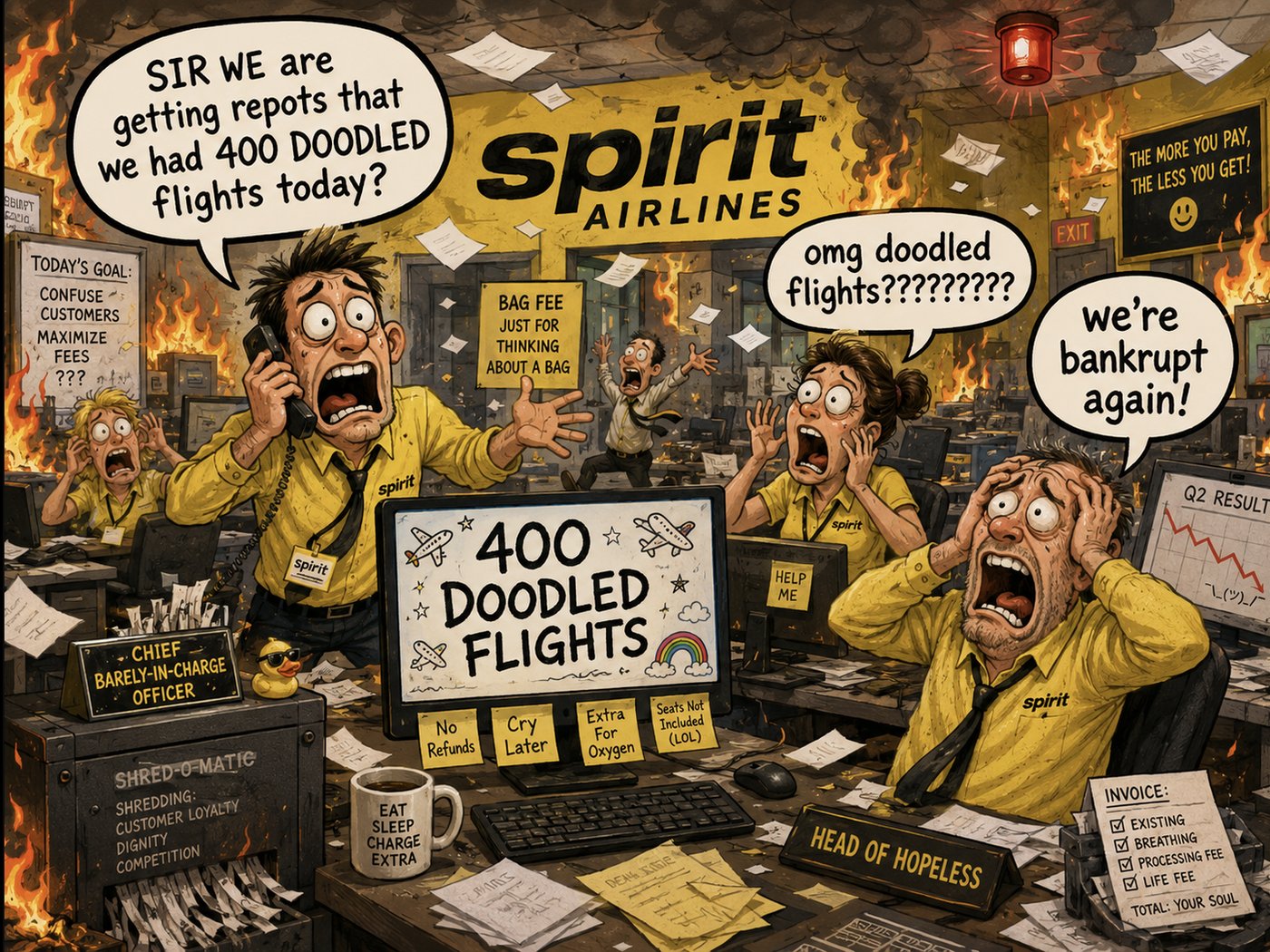
This dystopian hypothetical future is preventable. We are not helpless. We are harness engineers. We can use Pydantic AI Capabilities to apply constraints to an Agent. Those constraints can be human defined guardrails. With the GitHub READMEs referenced above I had my Fable 5.1 create a classifier to score generated spans of text. I will post the methodology in the appendix.
It's published as a PyPI package that you can run against any span of text with uvx vocabguard "some text ..."
You can uv add vocabguard to your project! Here's an example of using it on a Pydantic AI agent.
from pathlib import Path

from pydantic import BaseModel
from pydantic_ai import Agent

from vocabguard import OutputField, TextOutput, ToolArgument, VocabularyGuard


class CaseTicket(BaseModel):
    summary: str
    priority: int


def write_markdown(path: str, content: str) -> str:
    """Write a file under docs/."""
    target = Path(path)
    target.parent.mkdir(parents=True, exist_ok=True)
    target.write_text(content)
    return f'wrote {path}'

guard = VocabularyGuard(
    rewriter='openai:gpt-5.6-luna',
    targets=[
        OutputField(CaseTicket, lambda ticket: ticket.summary),  # a field of the structured output
        ToolArgument(write_markdown, 'content'),  # an argument of a tool call
        TextOutput(),  # the final text, when the agent answers in prose instead
    ],
    on_hit=lambda report: print(report.describe()),
)

# The agent files a ticket, or replies in text when there is nothing to file.
agent = Agent(
    'openai:gpt-5.6-luna',
    output_type=[CaseTicket, str],
    instructions='Triage bug reports. Write your working notes to docs/triage/<slug>.md, then file a ticket.',
    tools=[write_markdown],
    capabilities=[guard],
)

result = agent.run_sync(
    'Bug report: exporting a project with more than 200 assets hangs the desktop app at 97%. '
    'Reproducible on macOS and Windows since 3.4.1. Three customers affected, one enterprise.'
)
print(result.output)
Whenever vocabguard sees a model output from this agent that matches one of the targets declared (you can specify ToolArgument or OutputField if you're using Pydantic Structured Outputs), the vocabguard Capability will have its rewriter LLM attempt to rephrase the output. Alternatively you can specify no rewriter and it will raise a ModelRetry with phrasing and voice hints.
And since you can just run it as a command-line tool with uvx vocabguard you can wire up a Claude Code hook or mini Pi extension easily. You can also use it as a standalone tool like uv tool install vocabguard
I don't yet know if this will work well. Linguistic drift is a very serious concern and this is an afternoon of goofing around with Fable 5.1. Someone should absolutely do PhD level research on this. Someone should absolutely build a semi-realtime linguistic drift tracker.
Oh... looks like Nature is way ahead of me: The shrinking landscape of linguistic diversity in the age of large language models.
Give it a try, see how you like it. Maybe it'll keep the terminology sane. Pydantic AI Capabilities to the rescue. If only Spirit Airlines had used Pydantic AI Capabilities, they might have survived.
Thank you for reading!
Acknowledgements
- Eugene Geis wrote an interesting blog post with some parallels.
- Patrick Harrison gave me a great suggestion to enrich my dataset with GH Archive.
- Carson Sweet and Owen Zanzal for scintillating discussions in the Charlottesville Slack's #datascience and #ai channels.
- Pydantic for hiring me recently. <3
Appendix
Here's the overall classifier methodology. Critically, the algorithm regularizes affinity to topics. We see a lot more "agents", "CLIs", etc in 2026. This is natural linguistic drift that is related to the subject matter of technological advancement. We do not penalize this. Instead of topical language, we amplify the feature importance related to "voice" by tuning the gamma parameter.
The following methodology is entirely written by Fable 5.1.
We contrast two corpora of GitHub README prose labelled only by era, (4,319 documents, repositories with stars last pushed before 2025) and (1,047 documents fetched in 2026 from repositories with Claude Code commits), after stripping code, markup, and URLs, lowercasing, lemmatizing with simplemma, and counting unigrams and bigrams with stopwords retained.
For each -gram with counts and totals we compute the log-odds ratio under an informative Dirichlet prior [Monroe, Colaresi & Quinn, Political Analysis 16(4), 2008],
with and , standardized as
Because log-odds cannot distinguish a change in register from a change in subject, and topical terms are bursty while stylistic ones are dispersed [Church & Gale, Natural Language Engineering 1(2), 1995; cf. function-word stylometry in Mosteller & Wallace, 1964], candidates with are re-weighted by document evenness over the pooled corpora,
and the 1,000 largest form the watchlist .
A text with token sequence is scored
and the threshold is the cut maximizing balanced accuracy on a held-out 20% split of each corpus, where the scorer attains AUC [rank-based, Hanley & McNeil, Radiology 143, 1982] with true and false positive rates of and .
The same corpora without evenness weighting give AUC but rank agent first, whereas ranks every, across, and never first and reduces agent from to .