Pydantic AI Harness has come a long way since we launched it alongside Pydantic AI v2 in June. It's the official capability and harness library for Pydantic AI, with more than 100 capabilities you can add to any agent.
We're getting ready to call it 1.0 in about a month, and start maintaining the same version policy as Pydantic AI. That means this is the best time to stress test it and let us know if there's still anything we should change before the public API gets set in stone for a while.
Along with that, we're releasing Pax (pydantic-ai-pax), the official Pydantic AI coding agent for your terminal, built on the Harness SDK. Just as everything in the Harness is a capability, everything in Pax is a plugin: the coding agent itself, sandboxes, MCP, Logfire tracing, and your own. And you can bring your own harness: point Pax at any Pydantic AI agent with --agent. In single runs of Harness-Bench SWE81, it had the highest average score of the four harnesses that ran all eight models, narrowly. It cost less than half of what Codex did on GPT-6.2 Sol, and about the same as Claude Code on Claude Opus 5.5.
If you try it out, please let us know what you think in our Slack.
What is what?
Pydantic AI is the agent framework: the loop, models from every major provider, tools, and structured output. For reusable building blocks on top of that core, you pass Capabilities: bundles of tools, instructions, and hooks you can add to an agent.
Pydantic AI Harness is a library of production capabilities we've built so you can assemble a harness for your own use case. Built in: durable execution that survives crashes and restarts (for agents built on the SDK; not in Pax yet), one workspace API across your machine and a dozen cloud and local sandboxes, computer use on each provider's native tool, model fallback that also catches refusals, and code mode. Plus the table stakes: file and shell tools, guardrails, memory, sub-agents, context management and Agent Skills.
One of those capabilities is Coder(), our coding harness. What the industry calls a coding harness is, in Pydantic AI, just a capability (technically a bundle of capabilities that turns any agent into a coding agent).
Pax is the terminal UI in front of Coder(). Think of it as both a daily-driver coding agent and a showcase of what you can build on the Harness SDK: bring your own agent with --agent, swap sandboxes on the fly, and run any model.
Everything is a plugin
A Pax plugin is just a capability one layer up: tools and hooks for the agent, plus terminal pieces like /commands, status-bar items, and logins.
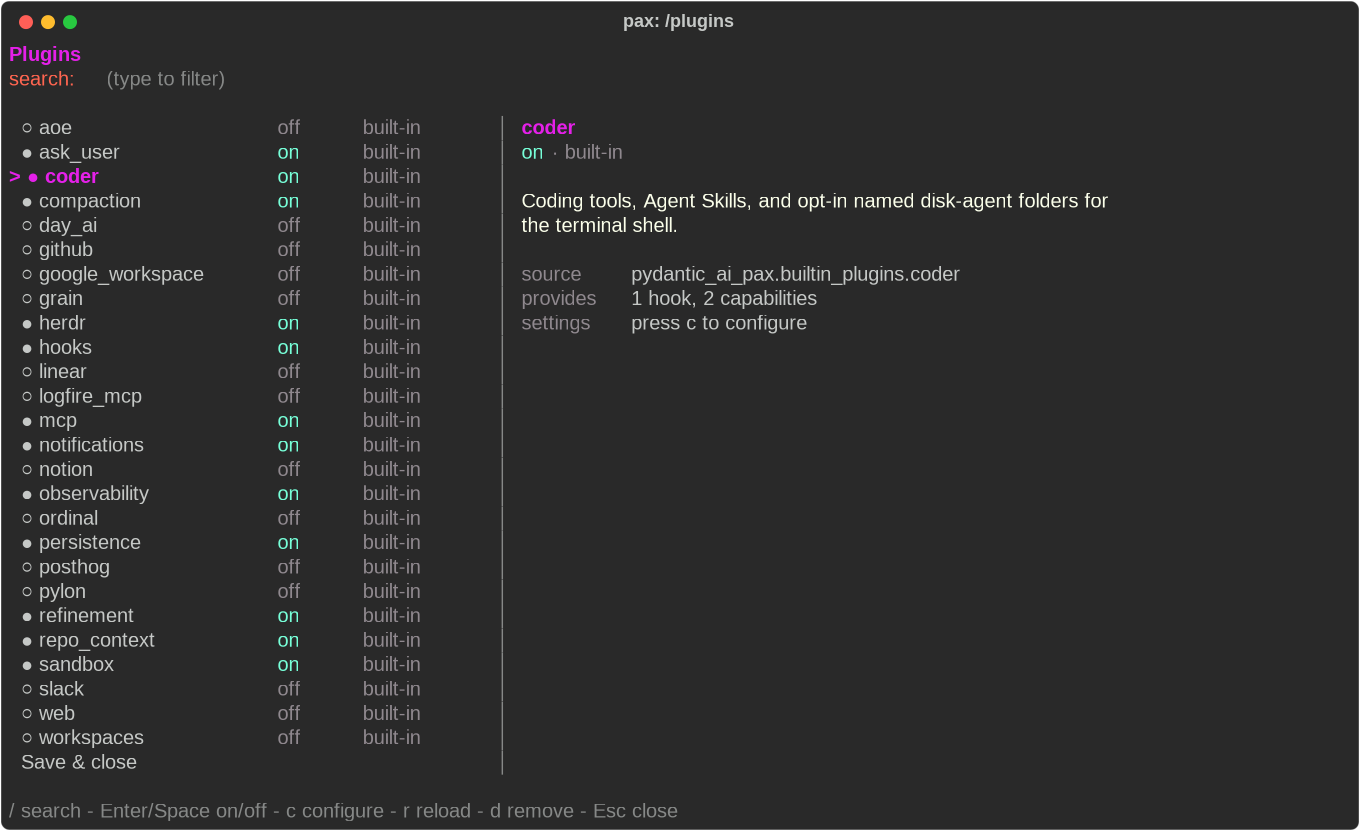
Even the coding agent itself is a plugin. Open /plugins to toggle coder, sandbox, observability (Pydantic Logfire tracing), mcp, and the rest on or off. Turn coder off with /plugins disable coder and you have a clean chat client with no file or shell tools. Any Pydantic AI capability works as a plugin by its import path, and Pax can even write new plugins for itself when you ask. See the Pax plugins docs.
Bring your own agent with --agent
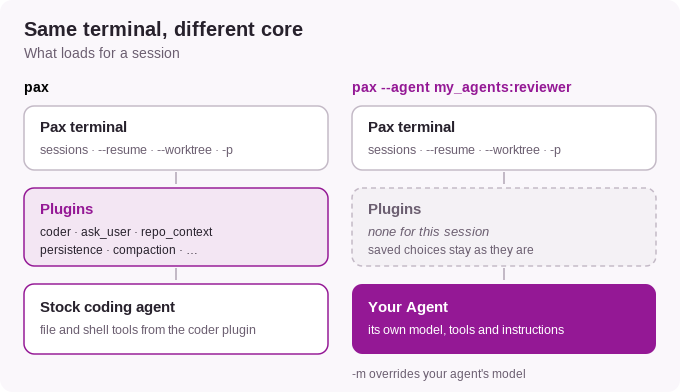
Plugins extend Pax's default agent. --agent replaces it with any Pydantic AI Agent from your codebase:
# my_agents.py
from pydantic_ai import Agent
from pydantic_ai.capabilities import LocalWorkspace
from pydantic_ai_harness import Coder

reviewer = Agent(
    'openai:gpt-6.1-sol',
    instructions='You review diffs against our internal engineering guidelines.',
    capabilities=[LocalWorkspace('.'), Coder()],
)


@reviewer.tool_plain
def get_guideline(topic: str) -> str:
    """Look up an internal engineering guideline by topic."""
    ...
pax --agent my_agents:reviewer
pax -a my_agents:reviewer -p "Review the diff on this branch against our guidelines"
Pax loads no plugins and runs your agent as-is with its own model, tools, and instructions (here Coder()'s file and shell tools in the current directory, plus your guideline lookup), while giving you the full terminal (--resume, --worktree, -p, and -m). Build an agent in your repo, test it in a real terminal, and ship the exact same Agent object in your service. See Pax in your own code.
Sandboxes and workspaces
File system and shell tools talk to a workspace, so the same agent runs on your machine or in a cloud sandbox without changing any tool code. Swap LocalWorkspace('.') for a sandbox capability, like E2BSandbox, and Coder()'s file and shell tools run there instead:
from pydantic_ai import Agent
from pydantic_ai_harness import Coder, E2BSandbox

agent = Agent('anthropic:claude-sonnet-5-5', capabilities=[E2BSandbox(), Coder()])
In Pax, you can swap where a session runs before the first prompt: /sandbox e2b (or boxd, daytona, opensandbox, modal, render, sprites, kubernetes) for a cloud sandbox, or /sandbox local smol / /sandbox local boxlite for a local smol or BoxLite micro-VM. Pax syncs your branch and uncommitted diff while every edit, build, and ! command runs inside the sandbox, and /resume reconnects automatically. On proxy-enabled providers (e2b, boxd, daytona, opensandbox), your GitHub token never enters the sandbox; the egress proxy injects it on outbound GitHub requests.
Computer use
Need more than a shell? Give any agent a full desktop in one line with ComputerUse() on Docker or any of ten sandboxes. It uses OpenAI's, Anthropic's, or Google's native computer-use tool automatically where supported:
from pydantic_ai import Agent
from pydantic_ai_harness import ComputerUse, DockerContainer

agent = Agent(
    'anthropic:claude-sonnet-5-5',
    capabilities=[DockerContainer(desktop=True), ComputerUse()],
)
result = agent.run_sync('Open Firefox and find the latest Python release on python.org.')
The model sees the screen, clicks, types, and gets a screenshot back after each step, all inside the sandbox.
In Pax, computer use is coming in the next release as /computer-use: run it in a new conversation before /sandbox PROVIDER, and the sandbox starts with a desktop the model can see and control through a computer tool. The desktop needs /permissions full, and /computer-use off takes the tool away again.
Code mode
Pax turns on code mode by default. Instead of burning turns shuffling results between tools, the model writes a short Python snippet in Monty that searches, reads files, and returns only what matters. Press Ctrl+X, then Ctrl+S for speculative execution so Pax starts safe file reads while the model is still streaming.
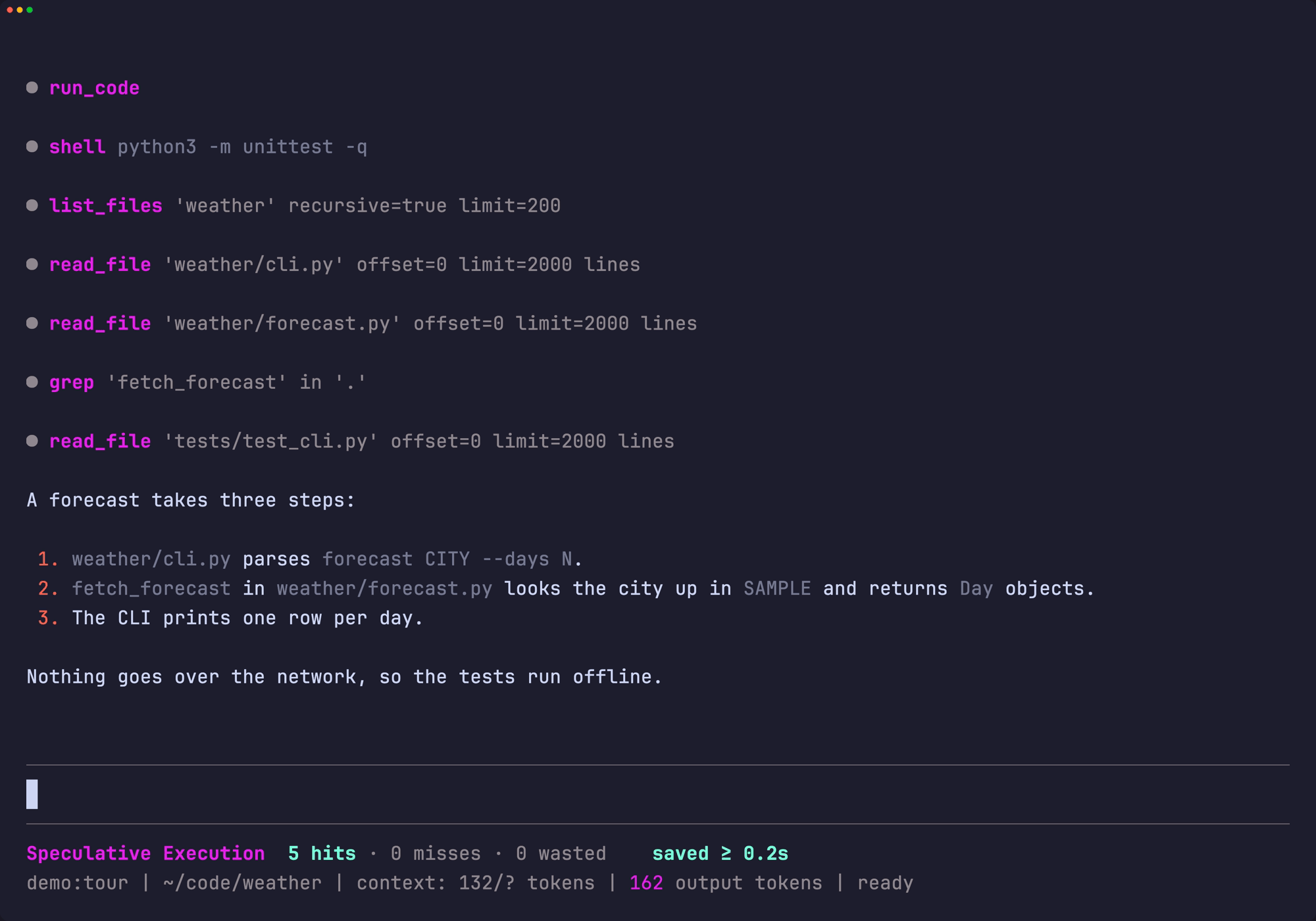
With the observability plugin, Pydantic Logfire still traces every tool call as its own span.
Migrating from another coding agent
Already using Claude Code or Codex? /resume shows your existing sessions right next to Pax's own, or import one directly with pax --resume-claude or pax --resume-codex and keep going on any model.
Your repo setup carries over too: repo_context reads AGENTS.md and CLAUDE.md, and the default coder plugin loads Agent Skills from .agents/skills and .claude/skills. (With standalone Coder() in Python, add Skills() alongside it if you want skills.)
How does it compare to other harnesses?
We've been benchmarking Pax against other harnesses on Terminal-Bench and Harness-Bench. Here's one illustrative result: Harness-Bench SWE81 across eight models, holding the model fixed within each comparison (higher score is better; lower cost is better). Pax had the highest average score of the four harnesses that ran every model, narrowly: 58.5, ahead of OpenCode at 58.2, deepagents-code at 57.6, and pi at 57.3. pi was the cheapest, averaging $6.47 a run to Pax's $7.69. Against the native harnesses, Pax cost $9.21 to Codex's $21.05 on GPT-6.2 Sol, and $24.61 to Claude Code's $25.10 on Claude Opus 5.5. Full methodology, more runs and more benchmarks are coming with the 1.0 launch.
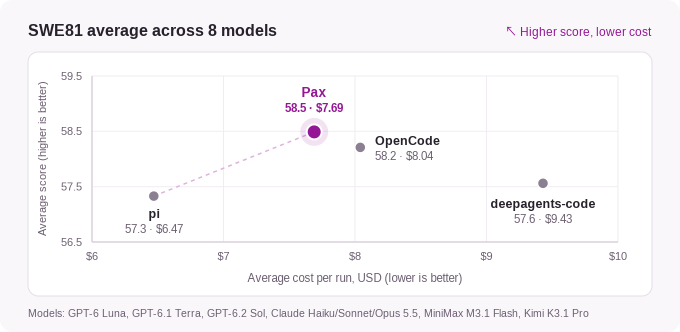
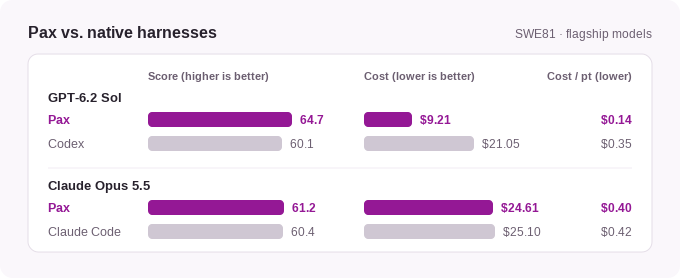
Single runs from November. Sol and Opus use a relaxed rescore applied identically to every harness, and Pax ran Sol with Coder(autonomy='max'), the setting for unattended runs that never stop to ask. Full methodology and reruns are coming with 1.0.
Full per-model SWE81 results (8 models, score and cost)
Score (higher is better):
| Model | Pax | OpenCode | pi | deepagents-code | Codex | Claude Code |
|---|---|---|---|---|---|---|
| GPT-6 Luna | 55.1 | 57.2 | 53.3 | 55.1 | 56.0 | n/a |
| GPT-6.1 Terra | 54.1 | 54.7 | 57.2 | 51.4 | 54.2 | n/a |
| Claude Haiku 5.5 | 56.0 | 55.5 | 52.9 | 59.1 | n/a | 56.5 |
| Claude Sonnet 5.5 | 58.4 | 60.8 | 57.9 | 57.7 | n/a | 56.9 |
| MiniMax M3.1 Flash | 54.7 | 50.8 | 52.3 | 50.7 | 54.7 | 38.6 |
| Kimi K3.1 Pro | 63.7 | 64.3 | 59.1 | 61.5 | 61.8 | 62.9 |
| GPT-6.2 Sol | 64.7 | 61.0 | 64.8 | 61.7 | 60.1 | n/a |
| Claude Opus 5.5 | 61.2 | 61.4 | 61.1 | 63.3 | n/a | 60.4 |
Average cost in USD of one run over all 81 tasks (lower is better):
| Model | Pax | OpenCode | pi | deepagents-code | Codex | Claude Code |
|---|---|---|---|---|---|---|
| GPT-6 Luna | $0.77 | $0.69 | $0.57 | $1.08 | $1.04 | n/a |
| GPT-6.1 Terra | $4.97 | $5.41 | $3.97 | $13.79 | $6.36 | n/a |
| Claude Haiku 5.5 | $1.46 | $1.50 | $1.20 | $1.34 | n/a | $1.37 |
| Claude Sonnet 5.5 | $7.90 | $7.43 | $6.54 | $7.90 | n/a | $6.86 |
| MiniMax M3.1 Flash | $1.67 | $2.94 | $1.40 | $2.92 | $1.85 | $2.95 |
| Kimi K3.1 Pro | $10.92 | $9.81 | $9.44 | $11.88 | $14.42 | $11.40 |
| GPT-6.2 Sol | $9.21 | $9.17 | $7.69 | $12.98 | $21.05 | n/a |
| Claude Opus 5.5 | $24.61 | $27.33 | $20.96 | $23.51 | n/a | $25.10 |
Scores are averaged over graded tasks. Costs use list-price tokens for OpenAI and Anthropic, and OpenRouter billed cost for MiniMax and Kimi. With the stock grader, Pax scored 51.0 on Sol to Codex's 49.8, and 54.9 on Opus to Claude Code's 53.5. In a separate head-to-head on GPT-6.1 Sol, Pax scored 62.4 to Codex's 63.0 for 29% less cost (8.0M vs. 20.8M input tokens per run).
Try the beta
Run uvx pydantic-ai-pax to try Pax without installing it, or uv tool install pydantic-ai-pax to keep it. macOS ships with an unrelated /bin/pax archiver installed by default, so if pax doesn't start Pax right after installing, open a new terminal (or run rehash in zsh / hash -r in bash) so your shell picks up the new PATH entry, or run pydantic-ai-pax directly.
Rather build your own harness? Start with the Harness docs.
We're heading toward 1.0 next month, so tell us what breaks and what you want to see in V1: join our Slack or file an issue.