

Announcement: Pydantic v2.14 Release
 Victorien Plot
 Trace production agents, turn failures into eval cases, and improve what ships with Pydantic Logfire. Bring your agents written in Python or TypeScript.
Continuously improve your agents with insights from your traces and evals. Protect your data and control your spend with Logfire AI Gateway.
No credit card required · 10M telemetry records free every month
Set up Logfire with your coding agent:
From the team behind Pydantic Validation
Trusted across the Python ecosystem and by engineering teams building the systems people rely on.
12×
faster issue resolution across more than 50,000 AI research workflows.
150×
faster trace queries, making live evaluation and agent self-correction possible.
20×
cost spike caught before it burned through the team’s budget.
The answer can be wrong even when every service is healthy. Evals that ignore production are exercises in creative writing: they test the cases you imagined, while the real failure sits in a tool call, model response, API, or database query.
AI tracing
Application monitoring
Logfire keeps the full execution path together, so you can debug what broke, evaluate what worked, and improve the agent from real production evidence.
Move from a symptom to the evidence that explains it—without stitching together separate tools or guessing from averages.
Evaluation
Synthetic test sets miss the failures users actually hit.
Turn production failures into eval cases and verify the fix.
Engineering
Tool sprawl turns incidents into archaeology.
Follow one request through every layer of the application.
Cost
Retries and model choices quietly burn budget.
See cost in context and cut what is not earning its keep.
Security
Sensitive data can cross more systems than expected.
Inspect the path, enforce policy, and retain the evidence.
Production evidence
See the agent’s decisions in the context of the systems they touch. Logfire connects model calls and tool use to the APIs, databases, queues, and infrastructure behind the result—so evals and fixes start with what actually happened.
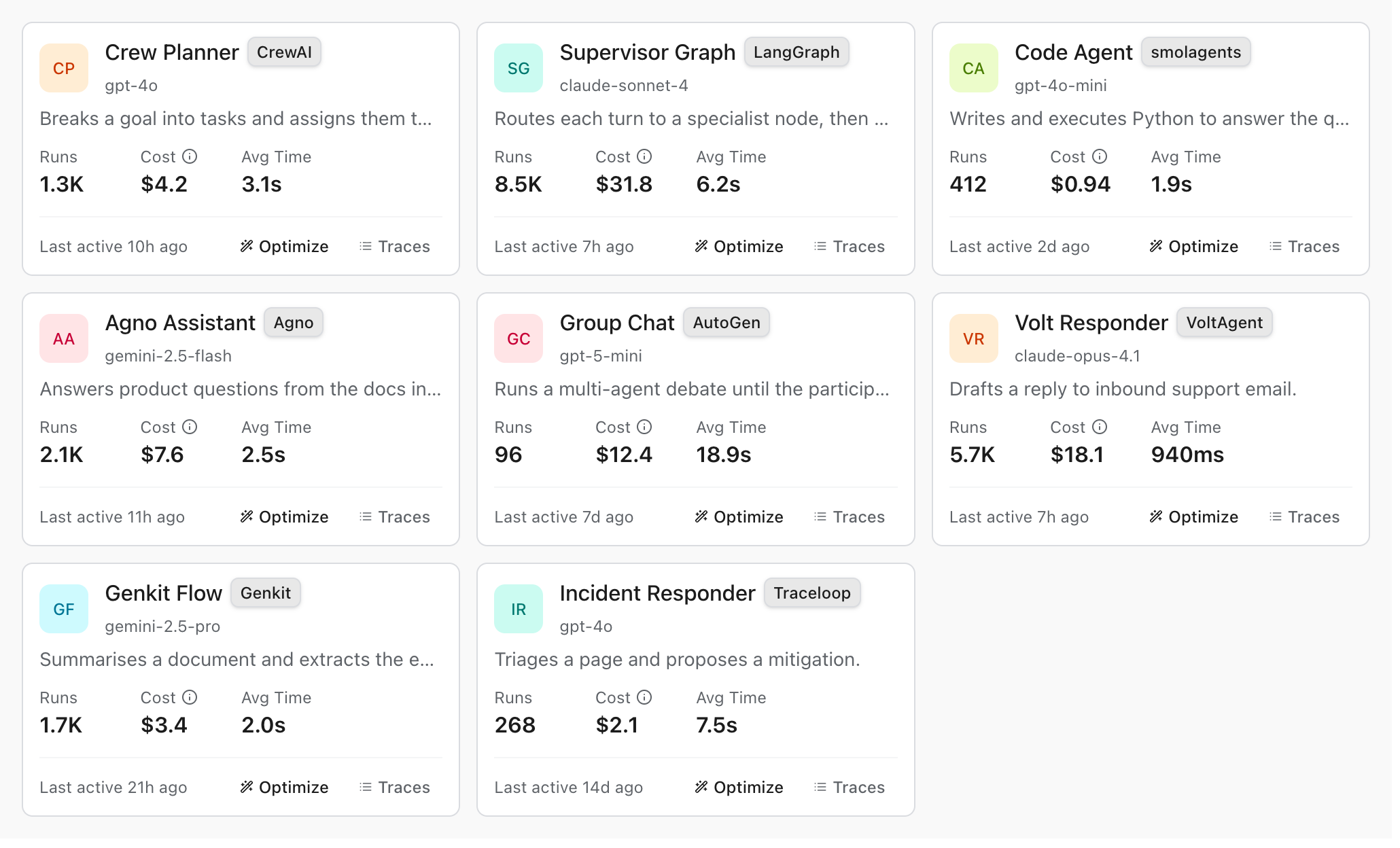
Integrations
Built on OpenTelemetry, with first-party SDKs for Python, JavaScript and TypeScript, and Rust. Trace agent frameworks, application code, databases, and the infrastructure underneath them without rebuilding your application around an observability vendor.
Follow agents and tool calls across verified OpenTelemetry paths, without tying production visibility to one framework.
Built on the tracing and OpenTelemetry ecosystem.
Keep the services, hosts, clusters, containers, and cloud metrics underneath each request in the same investigation.
Our mission
Pydantic did not start as a business idea. It started with a developer problem worth solving well. The team behind the validation library now brings the same obsession with clear APIs, useful defaults, and open standards to the whole AI engineering stack.
“ I started working on Pydantic out of frustration that type hints did nothing at runtime, and curiosity about whether they could validate data.
Pydantic’s growth means the maintainers behind it now get to build more products on the same principle: the most powerful tools can still be easy to use. ”

Samuel ColvinCreator of Pydantic@samuelcolvin
8 October 2026
Victorien Plot 5 October 2026
 Aditya Vardhan
 1 October 2026
 Antoni Kozelski
 30 September 2026
 Laís Carvalho
 29 September 2026
 Marcelo Trylesinski