Code Mode
CodeMode replaces individual tool calls with a single sandboxed Python execution environment. Instead of the model issuing one tool call per action, it writes a Python program that calls your tools as functions — with loops, conditionals, variables, and asyncio.gather — all inside a sandboxed Monty runtime.
Standard tool calling costs one model round-trip per tool call. An agent that needs to fetch 10 items and process each one makes 11+ model calls — slow, expensive, and heavy on context. The conversation history grows with every intermediate result, and everything runs sequentially unless the model deliberately batches parallel tool calls.
CodeMode wraps the agent’s tools into a single run_code tool. The model writes one Python snippet that orchestrates many tool calls locally: fan them out with asyncio.gather, filter and transform results in plain Python, and return only what matters.
| Standard tool calling | Code mode |
|---|---|
| 1 model call per tool | 1 model call for N tools |
| Sequential by default | Parallel via asyncio.gather |
| No local computation | Filter, transform, aggregate in code |
| Large conversation history | Compact — fewer messages |
Code mode requires the Monty sandbox, available via the codemode extra (the code-mode extra is an equivalent alias):
uv add "pydantic-ai-harness[codemode]"
Construct an Agent with CodeMode() in its capabilities, then register tools as usual. Every tool becomes callable from inside run_code:
from pydantic_ai import Agent
from pydantic_ai_harness import CodeMode

agent = Agent('anthropic:claude-sonnet-4-6', capabilities=[CodeMode()])


@agent.tool_plain
def get_weather(city: str) -> dict:
    """Get current weather for a city."""
    return {'city': city, 'temp_f': 72, 'condition': 'sunny'}


@agent.tool_plain
def convert_temp(fahrenheit: float) -> float:
    """Convert Fahrenheit to Celsius."""
    return round((fahrenheit - 32) * 5 / 9, 1)


result = agent.run_sync("What's the weather in Paris and Tokyo, in Celsius?")
print(result.output)
Inside a single run_code call, the model writes code like the following (illustrative — the exact code the model emits will vary):
import asyncio

paris, tokyo = await asyncio.gather(
    get_weather(city='Paris'),
    get_weather(city='Tokyo'),
)
paris_c = await convert_temp(fahrenheit=paris['temp_f'])
tokyo_c = await convert_temp(fahrenheit=tokyo['temp_f'])
{'paris': paris_c, 'tokyo': tokyo_c}
Both weather lookups run in parallel, the conversions run locally, and the whole thing collapses into one model round-trip instead of five.
By default, CodeMode(tools='all') sandboxes every tool. The tools field is a Pydantic AI ToolSelector, so you can control precisely which tools go through the sandbox. Tools that match the selector become callables inside run_code; non-matching tools stay visible to the model as regular tool calls.
from pydantic_ai_harness import CodeMode

# By name -- only these tools are available inside run_code
CodeMode(tools=['search', 'fetch'])

# By predicate -- (ctx, tool_def) -> bool | Awaitable[bool]
CodeMode(tools=lambda ctx, td: td.name != 'dangerous_tool')

# By metadata -- combine with SetToolMetadata or a toolset's .with_metadata()
CodeMode(tools={'code_mode': True})
Use metadata when the decision should travel with a tool or toolset, rather than with one CodeMode instance. This suits shared toolsets: the toolset author tags the tools that are safe and useful to call from generated code, and each agent opts into that tag with CodeMode(tools={...}).
CodeMode(tools={'code_mode': True}) uses the standard Pydantic AI ToolSelector metadata form. A tool is sandboxed when its ToolDefinition.metadata contains all of the selector’s key-value pairs. Extra metadata on the tool is fine, and nested dictionaries are matched by deep inclusion.
The common pattern is to tag an entire toolset with .with_metadata(...):
from pydantic_ai import Agent
from pydantic_ai.toolsets import FunctionToolset
from pydantic_ai_harness import CodeMode


def search(query: str) -> str:
    """Search the web."""
    return f'results for {query}'


def fetch(url: str) -> str:
    """Fetch a URL."""
    return f'contents of {url}'


search_tools = FunctionToolset(tools=[search, fetch]).with_metadata(code_mode=True)

agent = Agent(
    'anthropic:claude-sonnet-4-6',
    toolsets=[search_tools],
    capabilities=[CodeMode(tools={'code_mode': True})],
)
Here search and fetch are removed from the model-facing tool list and become callable functions inside run_code. Tools without metadata['code_mode'] == True stay visible as regular tool calls.
When you mark tools or whole toolsets defer_loading=True (Tool Search), CodeMode keeps them out of run_code while they’re undiscovered — they pass straight through, so Tool Search drives them as usual (sent on the wire with defer_loading on providers with native tool search; otherwise dropped until discovered, with a search_tools tool alongside run_code). Once the model discovers a tool it comes back with defer_loading=False, and from then on CodeMode folds it into run_code like any other tool, so it’s callable from generated code.
That fold-in grows run_code’s description, which invalidates the prompt-cache prefix once at the moment of discovery (turns with no discovery stay cache-warm). Two ways to avoid the bust:
-
Pass
dynamic_catalog=Trueto keeprun_code’s description static across discoveries. The catalog of sandboxed-tool signatures moves into the agent instructions (as a dynamicInstructionPart) and newly-discovered tools are announced viactx.enqueueinstead of by rebuilding the description:from pydantic_ai_harness import CodeMode CodeMode(dynamic_catalog=True)This pays off when paired with Tool Search: the tool-definitions block stays byte-stable so the prefix cache survives discoveries, at the cost of a larger (but cache-friendly) system prompt. With a fixed toolset and no Tool Search, the default keeps the system prompt shorter and is the better choice.
-
To instead keep a Tool Search corpus fully native — never folded into
run_code, but not callable from inside it — exclude it with atoolsselector; corpus members carrywith_nativeset to the managing native tool:from pydantic_ai_harness import CodeMode CodeMode(tools=lambda ctx, td: td.with_native is None)
The last expression in the snippet is automatically captured as the return value — the model does not need to print(). Reserve print() for supplementary logging: printed text is surfaced separately, wrapped alongside the last-expression result.
| Scenario | Return |
|---|---|
| No print output | Last expression value |
| With print output | {'output': '<printed text>', 'result': <last expression>} |
| Multimodal content (e.g. images) | Returned natively for model processing |
State persists between run_code calls within the same agent run — variables, imports, and function definitions carry over. Pass restart: true in the tool call to reset state.
Nested tool calls inside run_code produce their own spans when instrumented with Logfire or any OpenTelemetry backend — the easiest way to understand what code mode actually did, since each run_code span fans out into the tool calls the model issued from inside the sandbox. See the Pydantic AI Logfire docs for setup.
The run_code tool return also carries metadata with every nested call, keyed by call id:
from pydantic_ai import Agent
from pydantic_ai.messages import ToolReturnPart
from pydantic_ai_harness import CodeMode

agent = Agent('anthropic:claude-sonnet-4-6', capabilities=[CodeMode()])


@agent.tool_plain
def get_weather(city: str) -> dict:
    """Get current weather for a city."""
    return {'city': city, 'temp_f': 72}


result = agent.run_sync("What's the weather in Paris?")

for msg in result.all_messages():
    for part in msg.parts:
        if isinstance(part, ToolReturnPart) and part.tool_name == 'run_code':
            metadata = part.metadata or {}
            tool_calls = metadata['tool_calls']    # dict[str, ToolCallPart]
            tool_returns = metadata['tool_returns']  # dict[str, ToolReturnPart]
A representative run wires CodeMode up against an MCP server and a web search and asks it to find the most-discussed Hacker News story across three feeds, pull the comment thread and the submitter’s profile, and search the web for follow-up coverage. CodeMode collapses that into two run_code calls: the first fetches all three feeds in parallel via asyncio.gather, dedupes by id, filters by score, and ranks by comment count — in plain Python; the second batches the three follow-up calls (hn_get_thread, hn_get_user, duckduckgo_search) together.
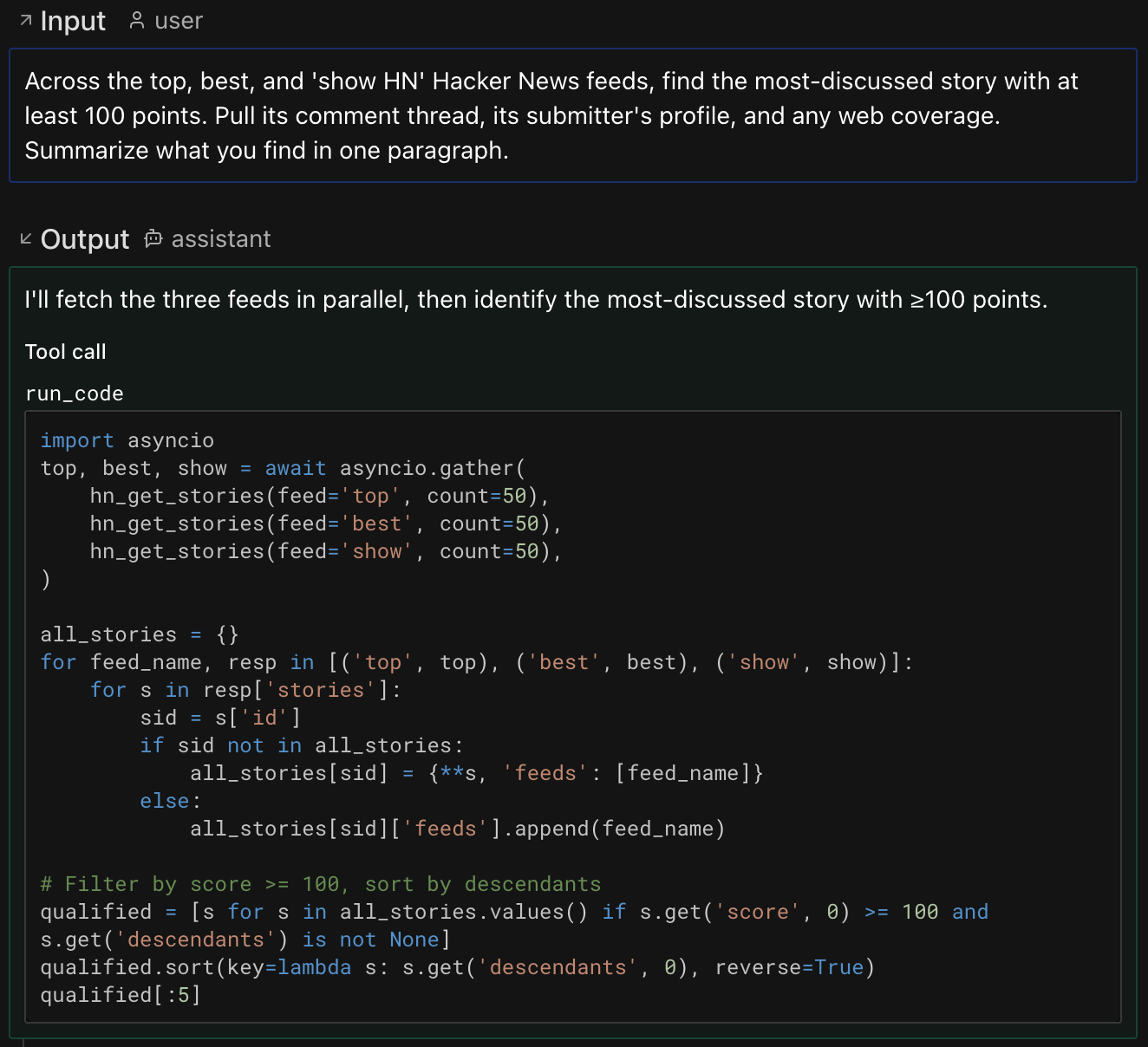
See the full Logfire trace -> Each run_code span fans out into the tool calls the model issued from inside the sandbox.
Sandboxed code runs with no access to the host’s files, environment, or clock. Two parameters grant it access — reach for them only when the agent’s task genuinely needs the host.
Both parameters are fixed when the capability is built, so construct CodeMode per request to scope host access to that request.
Reach for mount when the agent works with real files: analyzing a dataset you’ve dropped in a folder and writing a report back, editing a checkout, or processing a batch of documents. Sandboxed pathlib code reads and writes under the mounted path. (For environment variables or the clock, use os_access instead.)
from pydantic_ai import Agent
from pydantic_monty import MountDir
from pydantic_ai_harness import CodeMode

# The agent can read /work/data.csv and write /work/summary.md back to the host:
agent = Agent(
    'anthropic:claude-sonnet-4-6',
    capabilities=[CodeMode(mount=MountDir('/work', '/tmp/agent-workspace', mode='read-write'))],
)
A MountDir defaults to copy-on-write mode='overlay': the sandbox reads host files and sees its own writes, but those writes do not reach the host. Pass mode='read-write' to persist them, or mode='read-only' to forbid writes. mount also accepts a list of MountDir for multiple mount points.
Reach for os_access when the agent needs environment variables, the current date and time, or filesystem behavior you control. Hand it a ready-made OS implementation (AbstractOS), or a callback that decides each call — so you can inject just the secrets it needs, pin “now” for reproducible runs, or route file access to your own store.
from pydantic_ai import Agent
from pydantic_monty import OSAccess
from pydantic_ai_harness import CodeMode

# Give the agent a fixed set of environment values:
agent = Agent(
    'anthropic:claude-sonnet-4-6',
    capabilities=[CodeMode(os_access=OSAccess(environ={'API_BASE': 'https://api.example.com'}))],
)
A callback receives each OS call and decides its fate:
from pydantic_ai import Agent
from pydantic_monty import NOT_HANDLED
from pydantic_ai_harness import CodeMode

allowed_env = {'API_KEY': 'sk-...'}


def my_os(fn, args, kwargs):
    if fn == 'os.getenv':
        # Answer the call: allow-listed keys resolve, every other key reads back
        # as None -- absent, exactly like a real unset variable.
        return allowed_env.get(args[0])
    # Refuse everything else: NOT_HANDLED makes the call fail in the sandbox.
    return NOT_HANDLED


agent = Agent('anthropic:claude-sonnet-4-6', capabilities=[CodeMode(os_access=my_os)])
Your callback’s return value decides the call’s fate, and the two outcomes are easy to confuse:
- Return any value — including
None,'', or0— and that becomes the result the sandbox sees.os.getenvreturningNonelooks exactly like a normal unset variable, so the agent’s code keeps running. This is how you hide something: answer with an empty value. - Return
NOT_HANDLEDand the call is treated as unsupported: it raises inside the sandbox and the model gets a retry. This refuses a capability outright — use it to block, not to say “no value”. ReturningNOT_HANDLEDfor a key the agent reasonably expects will burn retries.
Code runs inside Monty, a sandboxed Python subset. Key restrictions:
- No class definitions.
- No third-party imports. Allowed stdlib modules:
sys,typing,asyncio,math,json,re,datetime,os,pathlib(each must be imported before use). - No wall-clock or timing primitives by default:
asyncio.sleep,datetime.datetime.now(),datetime.date.today(), and thetimemodule.datetime.datetime.now()/datetime.date.today()become available with anos_accesshandler (above);asyncio.sleepandtimenever do. - No
import *. - Filesystem I/O needs an
os_accesshandler or amount;os.getenv/os.environneed anos_accesshandler. - Tools requiring approval or with deferred (
CallDeferred) execution are sandboxed like any other tool; without aHandleDeferredToolCalls(or equivalent) capability on the agent to resolve them inline, calling one fromrun_coderaises an error that surfaces to the model as a retry.
CodeMode works with Pydantic AI’s agent spec feature for defining agents in YAML or JSON:
# agent.yaml
model: anthropic:claude-sonnet-4-6
capabilities:
  - CodeMode: {}
from pydantic_ai import Agent
from pydantic_ai_harness import CodeMode

agent = Agent.from_file('agent.yaml', custom_capability_types=[CodeMode])
result = agent.run_sync('...')
print(result.output)
Pass custom_capability_types so the spec loader knows how to instantiate CodeMode. Arguments can be passed in the YAML too:
capabilities:
  - CodeMode:
      tools: ['search', 'fetch']
      max_retries: 5
- Tool use via code (Anthropic)
- Code mode in production (Cloudflare)
- Pydantic AI capabilities
Bases: AbstractCapability[AgentDepsT]
Capability that exposes selected tools as callables inside a run_code sandbox.
By default (tools='all') every tool the agent has is wrapped behind a single
run_code tool — the model writes Python that calls them as functions instead
of issuing tool calls directly.
Pass a list of tool names or a callable predicate to tools to split the
toolset: matching tools become callables inside the sandbox, and the rest
stay visible to the model as normal tool calls.
from pydantic_ai import Agent
from pydantic_ai_harness import CodeMode

# Sandbox all tools
agent = Agent('openai:gpt-5', capabilities=[CodeMode()])

# Sandbox only specific tools
agent = Agent('openai:gpt-5', capabilities=[CodeMode(tools=['search', 'fetch'])])
By default, sandboxed code cannot touch the host — no filesystem, environment variables, or clock. Two parameters open it up:
mountshares specific host directories: reach for it when the agent reads or writes real files.os_accessroutes the sandbox’s OS calls to a handler you provide: reach for it when the agent needs environment variables, the clock, or filesystem behavior you control.
Both expose the real host to model-written code, so grant only what the task needs.
from pydantic_monty import MountDir

agent = Agent('openai:gpt-5', capabilities=[CodeMode(mount=MountDir('/work', '/tmp/agent-work'))])
Which wrapped tools should be sandboxed inside run_code.
'all'(default): every tool the agent has is sandboxed.Sequence[str]: only tools whose names are listed are sandboxed.- Callable
(ctx, tool_def) -> bool | Awaitable[bool]: tools where the callable returnsTrueare sandboxed; the rest stay as native tool calls.
Type: ToolSelector[AgentDepsT] Default: field(default='all')
Maximum number of retries for the run_code tool (syntax errors count as retries).
Type: int Default: 3
Give sandboxed code environment variables, the clock, and file I/O through a handler you provide; unset, they are unavailable.
Type: CodeModeOS | None Default: None
Host directories to expose to sandboxed pathlib code; each mount’s mode controls whether writes reach the host.
Type: CodeModeMount | None Default: None
Keep the run_code tool definition cache-stable as the sandboxed toolset grows.
By default the signatures of all sandboxed tools are rendered into run_code’s
description, which lives in the prompt-cache-keyed tool-definitions block. When the
toolset changes mid-run — e.g. ToolSearch
reveals a new tool that then gets folded into run_code — the description changes and
busts the prefix cache from that point on.
Set dynamic_catalog=True to instead:
- keep only the static base prose (sandbox restrictions, return-value contract) in
run_code.description, so the tool-definitions block stays byte-stable across discoveries; - move the “available functions” catalog (TypedDict definitions + signatures) into
agent instructions as a dynamic
InstructionPart, which providers with static/dynamic instruction splitting (Anthropic, Bedrock) place after the cache breakpoint; - announce newly-discovered tools via a short
SystemPromptPartenqueued throughRunContext.enqueue, so the model knows the new functions are callable without rewriting the cached description.
This pays off when paired with ToolSearch: the
tool-definitions cache survives discoveries at the cost of a larger (but
cache-friendly) system prompt. With a fixed toolset and no ToolSearch, the default
keeps the system prompt shorter and is the better choice.
Type: bool Default: False
def get_ordering() -> CapabilityOrdering
CodeMode wraps around ToolSearch so that search_tools stays native.
CapabilityOrdering
@async
def for_run(ctx: RunContext[AgentDepsT]) -> CodeMode[AgentDepsT]
Return a fresh instance so concurrent runs don’t share _announced_tools.
CodeMode[AgentDepsT]
def get_wrapper_toolset(
    toolset: AbstractToolset[AgentDepsT],
) -> AbstractToolset[AgentDepsT] | None
Wrap the agent’s assembled toolset, splitting it into native + sandboxed subsets if needed.
AbstractToolset[AgentDepsT] | None
@async
def after_tool_execute(
    ctx: RunContext[AgentDepsT],
    *,
    call: ToolCallPart,
    tool_def: ToolDefinition,
    args: ValidatedToolArgs,
    result: Any,
) -> Any
Announce newly-discovered tools from a local search_tools return.
Only active with dynamic_catalog=True. The native-search path is handled by
after_model_request instead
(server-side search emits a NativeToolSearchReturnPart rather than a regular tool
execute result).
@async
def after_model_request(
    ctx: RunContext[AgentDepsT],
    *,
    request_context: ModelRequestContext,
    response: ModelResponse,
) -> ModelResponse
Announce newly-discovered tools from a native (server-side) tool-search return.
Only active with dynamic_catalog=True.