Absurd Durability
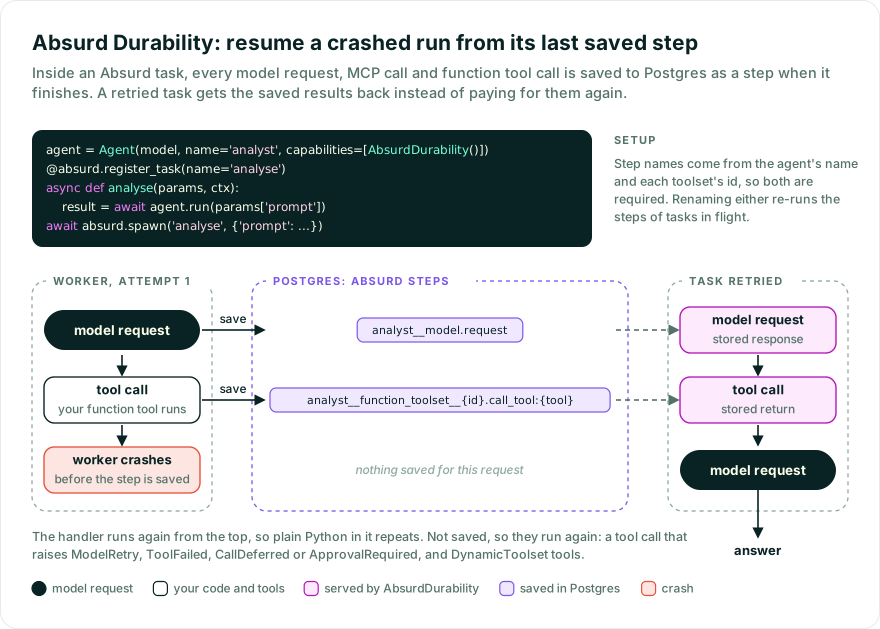
AbsurdDurability makes an agent run durable on Absurd,
a Postgres-based durable-execution engine. Run the agent inside an Absurd task handler and every
model request, MCP call, and function tool call is checkpointed as a step, so a worker that crashes
mid-run resumes from the last completed step instead of re-spending tokens on finished work. Outside
a task the capability is transparent.
While Pydantic AI Harness is on 0.x releases, the API may change between minor releases; when it does, deprecation warnings and release-note migration guidance tell you (or your agent) exactly how to upgrade. See the version policy.
pip install "pydantic-ai-harness[absurd]" "pydantic-ai-slim[openai]"
uv add "pydantic-ai-harness[absurd]" "pydantic-ai-slim[openai]"
Absurd stores its state in Postgres. Install the Absurd schema once per database (see the Absurd repository), then create a queue:
from absurd_sdk import AsyncAbsurd

absurd = AsyncAbsurd('postgresql://localhost/absurd', queue_name='agents')
await absurd.create_queue()
Give the agent a name, register a task handler that runs it, then spawn tasks from a producer and
execute them in a worker:
from absurd_sdk import AsyncAbsurd, AsyncTaskContext, JsonValue
from pydantic_ai import Agent
from pydantic_ai_harness.absurd import AbsurdDurability

absurd = AsyncAbsurd('postgresql://localhost/absurd', queue_name='agents')
agent = Agent('openai:gpt-6.1-sol', name='analyst', capabilities=[AbsurdDurability()])


@absurd.register_task(name='analyse')
async def analyse(params: JsonValue, ctx: AsyncTaskContext) -> JsonValue:
    assert isinstance(params, dict)
    result = await agent.run(params['prompt'])
    return {'output': result.output}


# Producer: enqueue a task.
await absurd.spawn('analyse', {'prompt': 'Summarize the Q3 report.'})

# Worker: claim and run tasks (in its own process).
await absurd.start_worker()
The handler must be async: a synchronous TaskContext raises a UserError.
After a crash, Absurd re-runs the task handler from the top. Plain Python in the handler runs again,
but each completed step returns its stored result instead of re-issuing the model request or tool
call. Step names are built from the agent’s name and each toolset’s id:
| Step name | Operation |
|---|---|
{name}__model.request | one model request segment |
{name}__model.request_stream | one streamed model request segment |
{name}__model.compact_messages | one model message-compaction operation |
{name}__model.cancel_suspended_response | tearing down a suspended response |
{name}__capability__{capability_id}.{operation} | an operation contributed by another capability |
{name}__function_toolset__{id}.validate_args | running a function tool’s args_validator |
{name}__function_toolset__{id}.call_tool:{tool} | a function tool call |
{name}__mcp_server__{id}.get_tools | listing an MCP server’s tools |
{name}__mcp_server__{id}.get_instructions | an MCP server’s instructions |
{name}__mcp_server__{id}.call_tool | an MCP tool call |
{name}__event_stream_handler | one event delivered to an event_stream_handler |
A model other than the agent’s default adds its id to the step name
({name}__model.request.{model_id}). A step name that recurs, such as a second agent.run() in
the same task or the same tool called twice, gets an encounter-order suffix (#2, #3, …). Await
one run before starting the next in the same task.
These are not checkpointed and run again on replay:
- a tool call that raises
ModelRetry,ToolFailed,CallDeferred, orApprovalRequired; - tools from a
DynamicToolset.
- The agent needs a
name(or passname=toAbsurdDurability), and every function, MCP, or dynamic toolset needs a uniqueid;Agent(...)raises aUserErrorotherwise. Don’t rename either once deployed: in-flight tasks re-run the steps whose names changed. - A checkpointed tool’s return value is stored as JSON, so it must be JSON-serializable.
- A step is checkpointed after it runs, so a crash between a tool’s side effect and its checkpoint
re-runs the tool. Keep side effects in tools and in an
event_stream_handleridempotent. - Function, MCP, or dynamic toolsets passed per run with
run(toolsets=...)inside a task raise aUserError; register them on the agent instead.ExternalToolsetis allowed. - Streaming inside a task is not live: the model stream is consumed inside the step, then its final response is replayed to the caller, one event per part.
- Under
BatchModelRequests, submitting a request and each check on its batch are steps, but the waits between checks are plain sleeps: the task has to keep running for as long as the batch takes, within its claim timeout, and a recovered run sleeps again through the waits it already did.
Tool calls run sequentially by default. Pass parallel_execution_mode='parallel_ordered_events' to
run them concurrently; plain 'parallel' is not supported. Stay sequential if a capability hook
such as before_tool_execute or wrap_tool_execute awaits before the tool runs, as that can
reorder concurrent calls of the same tool on replay.
AbsurdDurability composes with Code Mode: each tool call made from run_code is
its own step, served from its checkpoint on replay, while the run_code body itself re-runs.
Import AbsurdDurability and AbsurdParallelExecutionMode from pydantic_ai_harness.absurd
instead of pydantic_ai_absurd. Step names and checkpoint payloads match
pydantic-ai-absurd 0.8, so tasks in flight during
the switch resume without repeating work. A toolset without an id now needs one, and adding it
re-runs that toolset’s steps in tasks in flight. AbsurdAgent, AbsurdModel,
AbsurdFunctionToolset, and AbsurdMCPToolset are not ported; move to the capability first.
AbsurdDurability resumes a single run after a crash. Step Persistence
records runs so they can be resumed, forked, or replayed later as separate invocations. The two
compose.
Bases: BaseDurabilityCapability[AgentDepsT]
Capability that makes an agent durable by checkpointing its I/O into Absurd steps.
Run the agent inside an async Absurd task handler: every model request, MCP call, and function tool call becomes a step, so a retried task resumes from the last completed step. Outside a task the capability is transparent.
def __init__(
    *,
    models: Mapping[str, Model] | None = None,
    event_stream_handler: EventStreamHandler[AgentDepsT] | None = None,
    name: str | None = None,
    parallel_execution_mode: AbsurdParallelExecutionMode = 'sequential',
) -> None
Create an AbsurdDurability capability.
Optional additional models keyed by ID for runtime model switching via
agent.run(model='<id>'). The agent’s primary model is always registered as
'default'; the ID is folded into the checkpoint step name so a replay resolves
to the same model.
event_stream_handler : EventStreamHandler[AgentDepsT] | None Default: None
Optional event stream handler. Model events are handled live inside the model-request step; each tool event is handled in its own checkpointed step.
Unique agent name used as the prefix for every checkpoint step. Defaults to the
agent’s name when the capability is bound.
Tool-call execution mode applied to every run. 'parallel' is
excluded; see AbsurdParallelExecutionMode.
@async
def wrap_run(
    ctx: RunContext[AgentDepsT],
    *,
    handler: WrapRunHandler,
) -> AgentRunResult[Any]
Apply the configured parallel-execution mode to every run, inside a task or not.